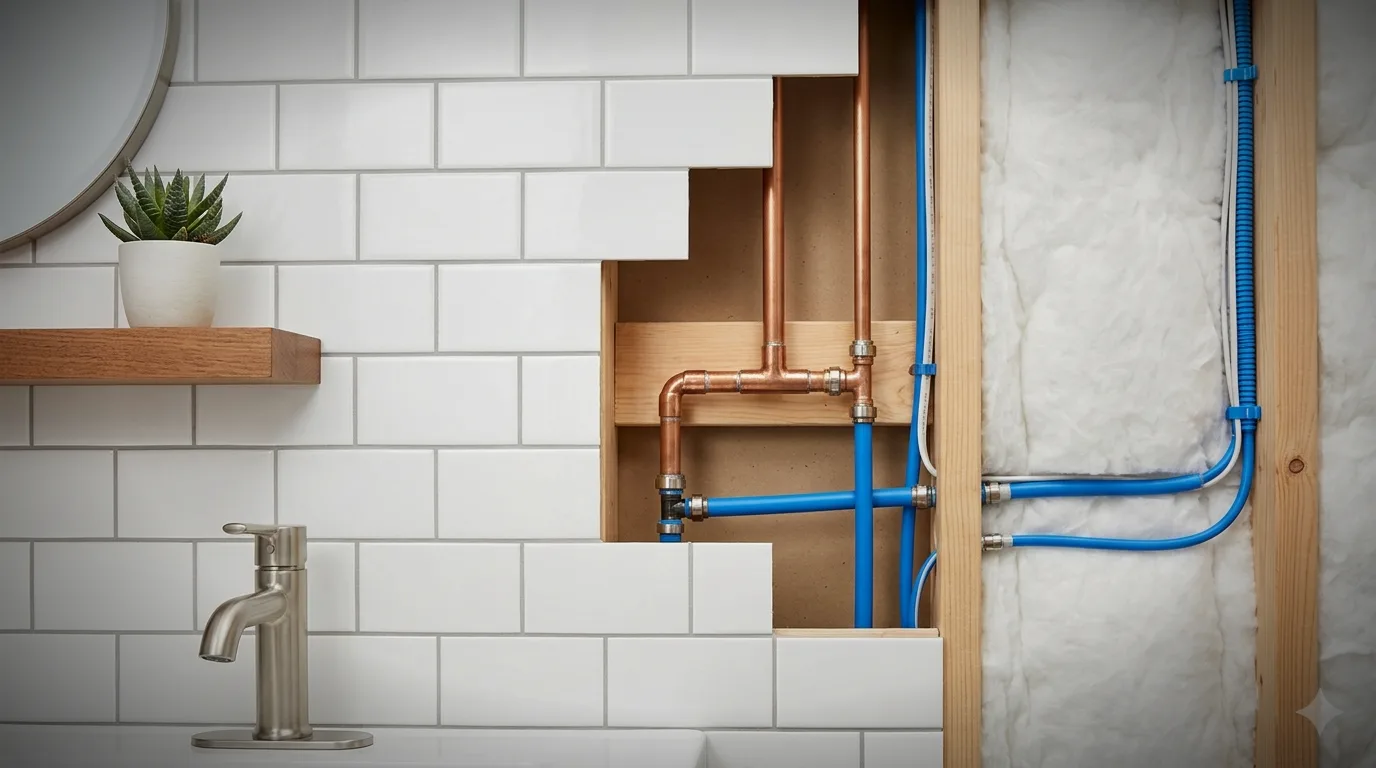
What's Behind Your Bathroom Walls Matters More Than What's on Them
You're About to Spend Thousands on Tile You Can See. Here's Why You Should Care More About What You Can't.
Every bathroom renovation starts the same way. You've been on Pinterest for six months. You know exactly which tile you want, which fixtures, which vanity. You've got a vision board that could make a designer weep.
But here's what nobody tells you at the tile showroom: the most important part of your bathroom renovation is completely invisible.
"The most important part of your bathroom renovation is completely invisible. It's behind the walls — and if your contractor gets it wrong, you won't know for three to five years."
It's behind the walls. Under the floor. Between the studs. And if your contractor gets it wrong — or worse, skips it — you won't know for three to five years. By then, you'll know by the smell.
We're talking about waterproofing. And in Houston, where humidity averages 75% and your bathroom generates steam twice a day, it's not optional. It's the foundation everything else sits on.
The Real Cost of Skipping What You Can't See
Here's why most homeowners don't budget for proper waterproofing: it's not on HGTV.
Nobody films the Schluter Kerdi membrane going up. There's no reveal moment for cement board installation. The BLS Producer Price Index shows construction materials are up 35% since 2020 — and when budgets get tight, the invisible stuff is the first thing a contractor "value engineers" out.
That's a polite way of saying they skip it.
And honestly? You'd never know. Not at the final walkthrough. Not when you're admiring your new rainfall showerhead. Not even six months later. The damage from inadequate waterproofing is slow, silent, and devastating.
Here's what happens when moisture gets behind your tile:
- Year 1-2: Nothing visible. Moisture is slowly migrating through unsealed joints and into the wall cavity.
- Year 3: A faint musty smell you can't locate. Maybe a small soft spot near the base of the shower.
- Year 4-5: Mold colonies established behind the drywall. Subfloor rot progressing. Tile starting to crack as the substrate shifts.
- The call: A remediation company quotes $12,000-$18,000 to tear out the entire bathroom, remediate the mold, replace the framing, and start over.
All because someone saved $1,500-$2,500 on waterproofing during the original renovation.
The Math That Should Change How You Think About Bathroom Budgets
Proper waterproofing for a standard Houston master bathroom: Schluter Kerdi membrane system $800-$1,200, cement board substrate $300-$500, professional installation labor $600-$800. Total: $1,700-$2,500.
Mold remediation and rebuild after waterproofing failure: demolition $2,500-$4,000, mold remediation $3,000-$6,000, structural repair $2,000-$4,000, complete bathroom rebuild $8,000-$15,000. Total: $15,500-$29,000.
That's a 7x to 12x multiplier. And here's the part that really stings: insurance rarely covers it. Most homeowner policies exclude damage from "gradual water intrusion."
"That's a 7x to 12x multiplier. And here's the part that really stings: insurance rarely covers gradual water intrusion."
What Actually Goes Behind the Walls
The Substrate: Cement Board vs. Drywall
If your contractor is putting tile directly on moisture-resistant drywall (green board), that's a red flag. Green board was designed for areas with occasional moisture — not a shower that runs twice a day in Houston humidity.
We use cement board (Hardiebacker or equivalent) for all wet areas. It cannot rot, it cannot grow mold, and it provides a rigid substrate that prevents tile cracking.
The Membrane: Kerdi vs. Paint-On vs. Nothing
Tier 1 — Sheet membrane (Schluter Kerdi): A polyethylene bonded membrane that creates a continuous waterproof barrier over the entire shower area. This is the system we install on every Craftwork bathroom.
Tier 2 — Liquid-applied membrane (RedGard, Hydroban): Effective when applied correctly — but the failure mode is human error.
Tier 3 — "The tile is waterproof": It's not. Grout is not waterproof. Thin-set is not waterproof. If this is your contractor's strategy, find a new contractor.
The Details: Slope, Drains, and Penetrations
- Shower floor slope: 1/4 inch per foot toward the drain, minimum.
- Drain connection: The membrane must integrate with the drain assembly, not just sit next to it.
- Penetrations: Every showerhead pipe, valve body, and niche shelf needs individual sealing.
- Curb waterproofing: Needs membrane coverage on the top, both sides, and a proper bond to the floor membrane.
How to Know If Your Contractor Takes This Seriously
1. "What waterproofing system do you use in showers?" You want to hear a specific system name — Schluter Kerdi, Laticrete Hydro Ban, USG Durock. 2. "Can I see the waterproofing before you tile over it?" At Craftwork, we photograph every waterproofing installation and send it to the homeowner before a single tile goes up. 3. "What's your warranty on waterproofing failures?" Schluter offers a system warranty when their products are used together as specified.
Ask your contractor three questions before signing: What waterproofing system do you use? Can I see it before you tile over it? What's your warranty on waterproofing failures? A confident, specific answer to all three is the baseline.
The Bottom Line
Your bathroom renovation has two audiences: you today, and you in ten years. At Craftwork, we don't hide the unsexy stuff — we lead with it. Because a contractor willing to talk about waterproofing membranes is a contractor who cares about what happens after the final walkthrough.
"A contractor willing to talk about waterproofing membranes is a contractor who cares about what happens after the final walkthrough."
Ready to see what "behind the walls" looks like on your project? Book a consultation.