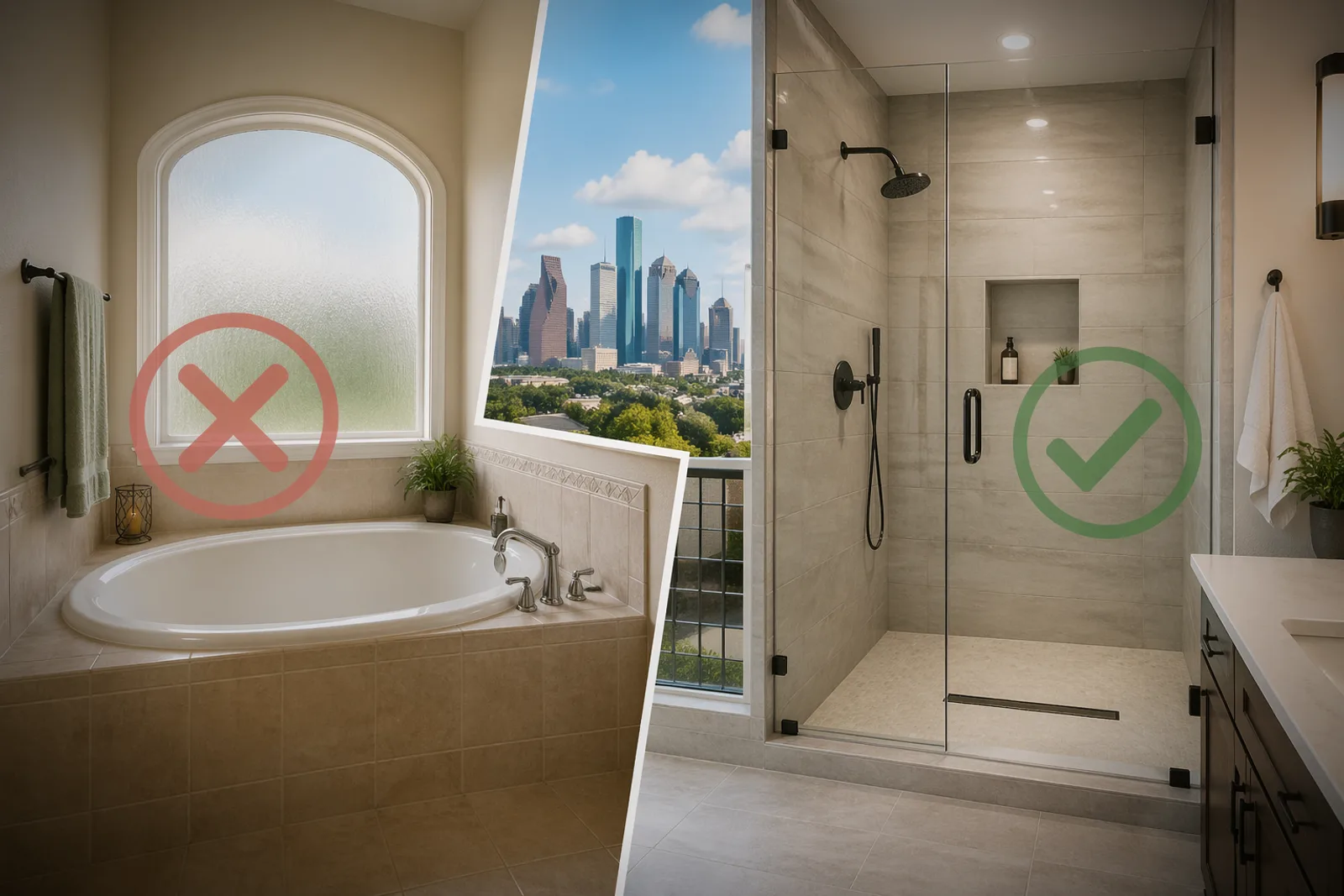
Rip Out the Garden Tub. Seriously. Here's Why Houston Is Converting to Walk-In Showers
That builder-grade soaking tub is wasting 20 square feet of your bathroom. Here's what it could be instead.
The Garden Tub Confession
Let's be honest about your garden tub. When you bought the house, it was a selling point — "master bath with soaking tub" reads well on a listing. You imagined candlelit bubble baths after long days, a spa experience in your own home.
How many times have you actually used it in the last year? If you're like 73% of Houston homeowners we survey during consultations, the answer is somewhere between "twice" and "I honestly can't remember."
"The garden tub has become the most expensive shelf in your house. It holds dust, a few candles that have never been lit, and maybe some kids' bath toys from two years ago."
Meanwhile, it's occupying 18 to 25 square feet of premium bathroom real estate — space that could be a walk-in shower you'd actually use twice a day. The tub-to-shower conversion isn't just a trend. It's a correction. Houston homeowners are recognizing what builders should have known all along: most master baths don't need two water fixtures when one great one will do.
What "Walk-In" Actually Means in 2026
A tub-to-shower conversion isn't replacing a tub with a standard 3-by-3 shower stall. That would be a downgrade. What we're building is a walk-in shower that transforms the full footprint of the former tub — plus often some adjacent floor space — into an experience. The components that make a Craftwork spa conversion feel like a destination instead of a fixture swap:
- Frameless floor-to-ceiling glass enclosure, not a shower curtain or a frosted glass door from 2005
- A rainfall overhead plus a handheld on a slide bar, giving you both the spa cascade and the practical rinse
- A built-in tile bench for shaving, products, and aging-in-place accessibility
- Recessed niches for shampoo and soap so nothing lives on the shower floor
- Curbless or low-curb entry so there's nothing to step over at 6 AM
Each of these gets its own short section below — they're the decisions that make or break the final result.
The Enclosure: Frameless Glass, Not a Curtain
The enclosure is the first thing you see when you walk into the bathroom, and it's the single biggest contributor to the "this feels bigger" illusion. Get it right and the whole room expands visually. Get it wrong and it reads as a shower stall in a disguise:
- Frameless glass panels in 3/8-inch tempered glass, not a framed kit
- Floor-to-ceiling height where the plumbing allows — full-height glass is what makes the bathroom feel larger
- One fixed panel plus one swing door, or a single fixed panel with a curbless walk-in entry
- Minimal hardware — use hinges and clips in a finish that matches the faucet, not a contrasting chrome
The Showerhead System: Two Heads Are Better Than One
The fixture choice is where the spa experience lives or dies. A rainfall head alone is beautiful but impractical for rinsing; a handheld alone is functional but forgettable. The combination is the point:
- Rainfall overhead 10 to 12 inches across, mounted flush to the ceiling for a wide, gentle cascade
- Handheld on a slide bar at adjustable height for rinsing, cleaning the shower, and washing kids
- Thermostatic valve (Hansgrohe iBox or Grohe Grohtherm) so water temperature stays constant when someone flushes a toilet elsewhere in the house
- Optional body jets at shoulder and hip height — adds $400 to $800 in plumbing rough-in but delivers genuine hydrotherapy
The Bench and Niche: Built-In, Not Bolted On
The built-in tile bench and recessed niches are the features clients mention six months after the renovation — the ones they didn't know they needed until they had them. Specs that work:
- Corner bench or full-width bench at 17 to 18 inches high — usable for sitting, as a shaving ledge, and for aging-in-place accessibility
- One large recessed niche at 12 by 24 inches, or two smaller stacked niches
- Trim the niche in matching field tile or a contrasting accent strip
- No suction-cup caddies. Anything that needs a home gets a home in the wall
Waterproof the entire shower with a Schluter Kerdi system, not just liquid-applied membrane at the seams. Houston humidity is unforgiving and a failed waterproofing job is a $12K to $18K tear-out. This is non-negotiable.
The Morning Upgrade: Why This Changes Your Daily Routine
Here's what most renovation content gets wrong about bathrooms. They focus on how the room looks. But you don't look at your bathroom — you experience it. With your eyes half-open. At 6:15 in the morning.
The tub-to-shower conversion changes the first 15 minutes of every day.
Before the conversion, you step over the tub edge (ankle hazard). You stand in a 32-by-32 shower stall with a plastic door. Water hits you from one direction at whatever temperature the old mixing valve decides. You reach around the curtain for the shampoo that fell again. You rush because the space feels cramped and clinical.
After the conversion, you walk into a curbless or low-curb shower. Warm water cascades from a 12-inch rainfall head. There's no door to push against. The bench is there if you want to sit for a minute. Your products are in the niche at eye level. The space is warm, open, and quiet.
The difference isn't luxury. It's quality of life, multiplied by 365.
"The kitchen matters at dinner. The shower matters at dawn. Most homeowners don't realize how much of their daily quality of life lives in the first 15 minutes of the day until they fix them."
Accessibility matters too. A curbless or low-curb walk-in shower isn't just a design choice — it's aging-in-place infrastructure. No tub edge to step over means this bathroom works when you're 40, 60, and 80. The grab bar that looks like a towel bar. The bench that's both beautiful and functional. These aren't add-ons. They're built into the design from the start.
The Numbers: What a Conversion Costs in Houston
A Craftwork tub-to-shower conversion is not a weekend project and it's not a big-box estimate. Here's the real-world cost breakdown for a properly built, properly waterproofed Houston conversion:
- Demolition (tub, surround, subfloor, haul-away) — $800 to $1,500
- Plumbing reconfiguration (moving drain, adding valves for rainfall plus handheld) — $1,500 to $3,000
- Waterproofing with the Schluter Kerdi system — $1,200 to $1,800 (non-negotiable in Houston humidity)
- Tile for walls and floor in large-format porcelain — $2,500 to $5,000
- Frameless glass enclosure — $1,500 to $3,500 depending on configuration
- Fixtures (rainfall plus handheld, Hansgrohe or Grohe) — $600 to $1,500
- Built-in tile bench and niche — $400 to $800
- Total typical range — $8,500 to $17,000
The sweet spot for most Houston master baths lands at $11,000 to $14,000. That number gets you a properly waterproofed, large-format tile walk-in with rainfall and handheld fixtures, frameless glass, a built-in bench, and a niche — everything in the spa package without the ultra-luxury markup.
Does Removing a Tub Hurt Resale?
This is the question every homeowner asks — and the answer has changed dramatically in the last five years.
The old rule, broadly true through 2018 and 2020, was that every home needed at least one bathtub for resale. Families with young children still prioritized tubs, and realtors coached sellers to keep them.
The 2026 reality in Houston is different. According to Houston Association of Realtors data, homes with a walk-in shower in the master bath sell for 2.5 to 4% more than comparable homes with a garden tub — when the rest of the house has at least one bathtub, typically in a secondary bathroom.
"You don't need a tub in the master. You need a tub in the house. The distinction is worth $8,500 to $13,600 in resale value on a median Houston home."
The key distinction: you need a tub in the house, not in the master bath. If your home has a secondary bathroom with a tub/shower combo (which most Houston homes do), converting the master garden tub has zero negative impact on resale — and measurable positive impact.
Run the ROI math on a $12,000 conversion against an average Houston home value of $340,000. A 2.5 to 4% premium adds $8,500 to $13,600 in value. That's a 71 to 113% ROI, meaning you recover the full cost and often more at resale.
Compare that to the garden tub's contribution to your home value: approximately zero. Appraisers don't add value for a tub nobody uses. They add value for a bathroom that feels modern, functional, and well-built.
Before converting, confirm you still have a tub in at least one other bathroom in the house. If the master is your only tub, keep it (or add one elsewhere first) — the resale math flips when there's no bathtub anywhere on the property.
Fixtures Worth the Investment
Not every fixture dollar pays back equally. These three upgrades deliver the biggest daily-experience return per dollar and every one is worth paying for even in a tight budget:
- Thermostatic valve (Hansgrohe iBox or Grohe Grohtherm) at $400 to $700 — maintains exact water temperature regardless of what else is running in the house, the invisible upgrade that transforms the daily experience
- Quality rainfall showerhead (Hansgrohe Raindance) at $250 to $500 — the difference between a drizzle and a cascade, with a larger head diameter and air-injection technology for a fuller spray pattern
- Frameless glass in 3/8-inch tempered at $1,500 to $3,500 — transforms the visual openness of the bathroom, and thicker glass feels more substantial and resists flexing
Fixtures With Diminishing Returns
These upgrades sound exciting in the showroom and under-deliver in daily life. Skip them on a standard conversion and put the money into the core fixtures above:
- Digital shower controls with LED display at $800 to $2,000 premium over thermostatic — cool tech that adds complexity and repair cost for marginal daily benefit
- Steam shower conversion at $3,000 to $6,000 additional — requires vapor-tight enclosure and a dedicated steam generator, amazing if you'll use it four-plus times a week, expensive dust collector if you won't
- Body jets beyond four — each additional jet adds $200 to $400 in plumbing, and four jets at shoulder and hip height already deliver 90% of the hydrotherapy benefit
The Bottom Line
The garden tub was a builder's concession to a checklist, not a homeowner's need. It exists because "soaking tub" sounded good on the MLS listing — not because anyone studied how Houston families actually use their master bathrooms.
The walk-in shower is the correction. It's a fixture you use every day, designed for comfort, built for accessibility, and backed by resale data that makes the investment obvious.
At Craftwork, we've done more tub-to-shower conversions than any other single project type. We know the plumbing challenges, the waterproofing requirements, and the fixture combinations that deliver the spa experience without the spa price tag.
Ready to reclaim your bathroom from the tub nobody uses? Book a bathroom consultation and we'll walk your space, price the scope against your neighborhood comps, and show you exactly what the morning could feel like.