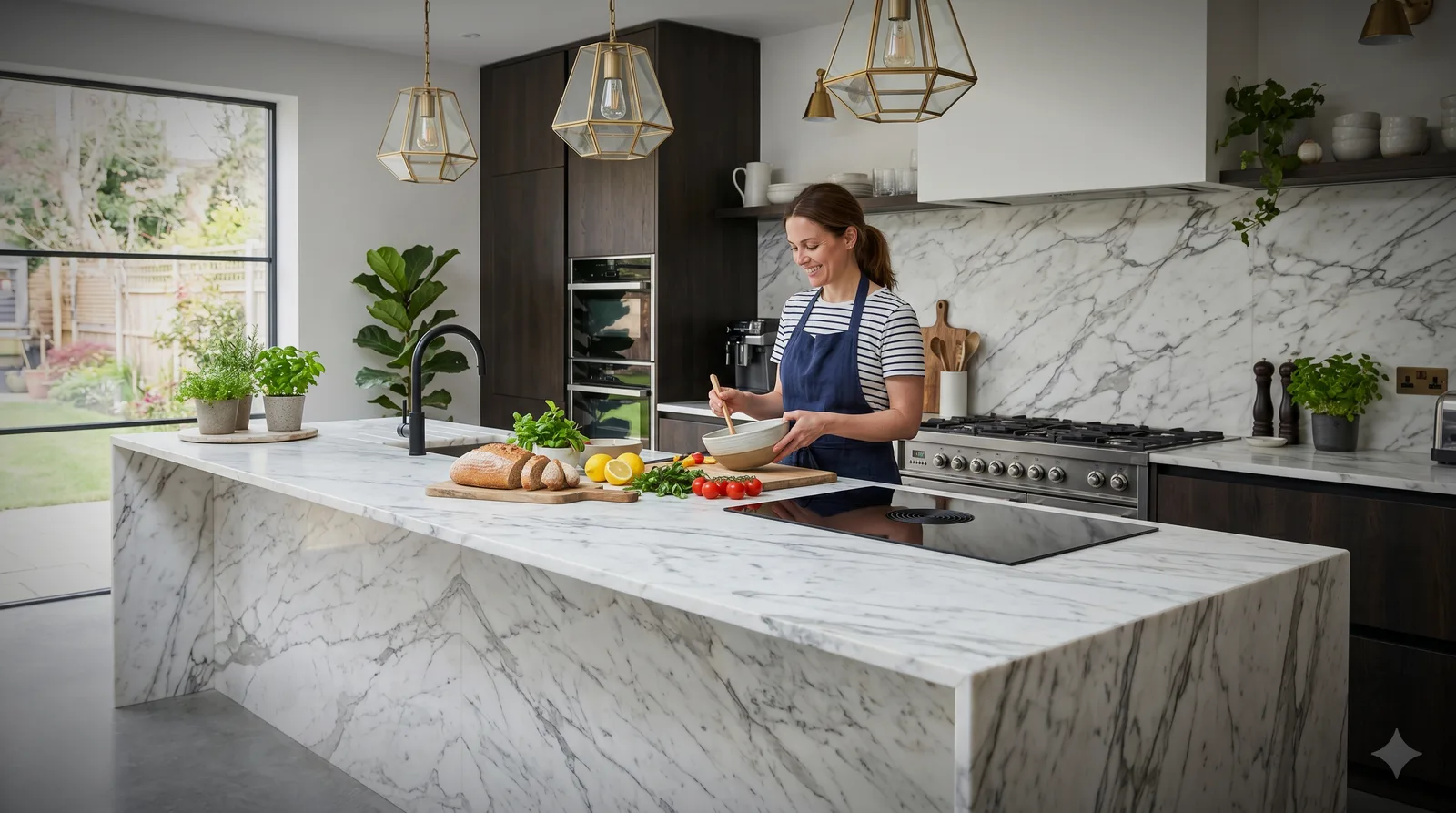
Why Marble Still Belongs in the Modern Kitchen
Natural stone is not a trend — it is a commitment to permanence. Here is how we think about marble in contemporary spaces.
For years, the design press oscillated between celebrating marble and declaring it overdone. In our work, that conversation misses the point. Marble is not a finish you chase for Instagram; it is a surface that ages with the home — patina, etching, and all.
"The best kitchens do not look installed overnight. They look settled, lived-in, and intentional."
We specify marble when the architecture calls for weight: a long island that anchors an open plan, a backsplash that catches morning light, or a powder room where a small surface area makes a quiet statement. Veining becomes the artwork — no canvas needed.
The case for imperfection
Every ring left by a wine glass, every faint etch from a lemon wedge — these are not failures. They are evidence of a kitchen being used the way kitchens are meant to be used. Marble develops character in a way that engineered surfaces simply cannot replicate. That is either a dealbreaker or the entire point, depending on how you think about your home.
We find that clients who choose marble tend to be the ones who already understand this. They are not looking for pristine; they are looking for authentic. A marble counter ten years in tells a story. A quartz counter ten years in looks like it did on install day. Neither is wrong — but they serve very different philosophies of living.
Choosing the right stone
Not all marble is created equal. The variety you select affects everything from maintenance frequency to how dramatically veining reads across a large surface. Here are the types we reach for most often in our kitchen work.
- Calacatta — bold, high-contrast veining with warm gold undertones. Best for statement islands and feature walls where the stone is the focal point.
- Carrara — softer gray veining on a whiter base. More subtle, more forgiving, and typically more affordable. Excellent for full-slab backsplashes.
- Statuario — dramatic thick veining on a bright white field. Reads as sculptural. We reserve it for spaces with minimal visual competition.
- Danby — an American marble from Vermont with a tighter grain and excellent density. Performs better than Italian varieties in high-use kitchens.
Always view marble slabs in person before committing. Photos flatten veining and distort color. We take clients to the stone yard so they can see exactly which slab will end up in their kitchen — because every piece is unique.
Pairing and care
Warm brass, matte black, and wire-brushed oak all speak the same language as honed or leathered marble — less glare, more tactility. We walk clients through sealing rhythms and realistic expectations so the material feels like a choice, not a surprise.
- Honed finish pairs beautifully with matte hardware and natural wood tones
- Leathered finish hides etching better and adds a subtle texture
- Polished finish is traditional but shows wear more readily — best in low-use areas
- Seal every six to twelve months with a quality impregnating sealer
If you are deciding between quartz and marble, ask whether you want a surface that stays visually static or one that records time. Neither is wrong — but only one is marble.
"Marble does not pretend to be indestructible. It asks you to care for it — and rewards you with something no factory can produce."