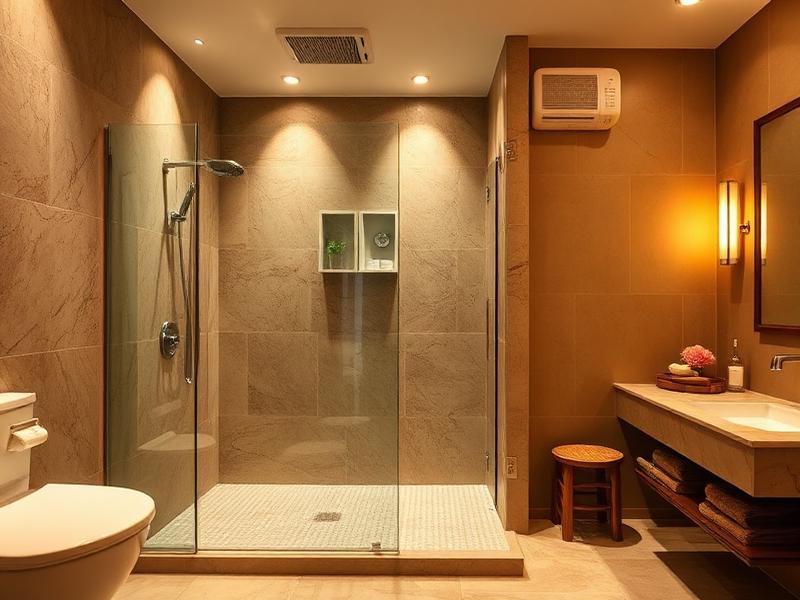
The Bathroom Renovation for the House You Live in Now
When the kids move out, or three generations move in, or you inherit your aunt's 1970 Bellaire ranch — the main bathroom is the first room that stops fitting.
The Moment the Bathroom Stops Being "Fine"
For most Houston homeowners, there's a specific moment when the bathroom they've been ignoring for fifteen years suddenly becomes unignorable. It's rarely dramatic. Usually it's one of these:
- The kids left for college and you walked into their bathroom for the first time in a year and realized it was also your bathroom and it was built for them, not for you
- Your mother moved in after your father passed and the shower has a 6-inch curb and a glass door that swings the wrong way
- You inherited the Montrose bungalow from your aunt and the bathroom is original to 1968 — peeling fiberglass surround, a tub you'd need a step stool to enter, and yellow tile that is somehow both dated and weirdly charming
- You had a near-slip getting out of the shower and it wasn't funny, it was a warning
Any of those moments is the start of this post. You're not renovating because you're bored. You're renovating because the life you're living now doesn't fit the bathroom the house came with.
Rename "Aging in Place" — It's Wellness Design
The industry calls bathrooms designed for older adults "aging in place" renovations. That phrase should be retired. It's technically accurate and emotionally awful. It signals frailty, institutional care, and the slow surrender of capability. Nobody wants to buy a renovation that carries those connotations, so they put it off, and then something bad happens.
Here's the reframe that actually works. It's wellness design. The features that make a bathroom safer for a 70-year-old are identical to the features that make a bathroom more luxurious for a 45-year-old. This is not marketing spin — it's a convergence:
- A curbless walk-in shower is universal design (accessible to wheelchairs) and also what every high-end spa builds — same feature
- A built-in bench in the shower is for someone who can't stand for 15 minutes and also for someone who wants a place to put a leg up to shave — same feature
- Designer grab bars from Moen, Kohler, and Hansgrohe are rated for 250-pound loads and also look like towel bars — same feature
- Heated floors prevent falls from a cold slippery morning floor and also feel incredible in January — same feature
- Layered lighting with a dimmer allows a person with low vision to see clearly and also creates a spa ambiance at 9 PM — same feature
"Aging in place is technically accurate and emotionally awful. Call it wellness design and the whole conversation — and the whole product — changes."
If you describe the renovation as "spa bathroom with universal design principles," you get a product that serves a 40-year-old and an 80-year-old with equal grace. Describe it as "aging in place" and you get a product that looks clinical and that nobody wants. Language matters. For this renovation, language is half the battle.
The Houston Layer: Why This Isn't a Pinterest Project
Here's where a lot of bathroom renovations in Houston go sideways. Homeowners see a magazine bathroom from Portland or Minneapolis and try to replicate it — and then the humidity, the pier-and-beam foundation, and the water hardness all conspire to make the magazine bathroom fail in three years.
Humidity runs 75% year-round in Houston. Materials that work in dry climates fail here. Marble and limestone in a Houston shower grow mold within the grout joints within 12 to 18 months. Natural wood vanities warp. Paint films delaminate. Bathroom exhaust fans rated for 50 CFM aren't enough — you need 80 to 110 CFM minimum to keep humidity from condensing on surfaces after a shower. These aren't luxury upgrades, they're Houston tax.
Pier-and-beam homes, common in pre-1970 Houston construction, move with the seasons. If you own an older Heights or Montrose bungalow, the subfloor flexes seasonally. Large-format porcelain tile installed without a proper uncoupling membrane (Schluter-Ditra or equivalent) will crack within five years. A generic national-franchise contractor doesn't know this. A Houston contractor learns it the hard way and then never forgets.
Water hardness in Houston runs 120 to 200 mg/L — hard enough that unsealed grout, standard fixtures, and cheap showerheads will scale and stain within months. Higher-quality fixtures (Hansgrohe, Grohe) have ceramic cartridges that tolerate this. Cheap fixtures don't. The $120 Home Depot fixture will need to be replaced in 3 to 4 years. The $380 Hansgrohe version will still be fine in 15 years. You pay once or you pay three times.
And pre-1985 homes may have galvanized pipes behind the walls. If your house is old enough, the rough-in plumbing is galvanized steel corroding from the inside. A bathroom renovation that doesn't address the supply lines just plants a $15K time bomb. This is expensive to fix proactively and catastrophic to fix reactively. A Houston contractor will find this. A contractor who flies in from out of town will not.
Specify an 80 to 110 CFM exhaust fan, not the 50 CFM builder standard. In Houston humidity, an undersized fan can't clear the room fast enough and the moisture condenses on every surface after every shower. This is the number one silent killer of bathroom finishes in Houston.
The Empty Nester Bathroom
If the kids have moved out and you're ready to claim the main bathroom back, here's what that renovation usually looks like in Houston. The moves that deliver the biggest daily-quality-of-life return:
- Remove the soaking tub you haven't used in four years and replace it with a walk-in shower using the same footprint — 78% of bathroom remodels now upgrade the shower versus 42% that upgrade the tub (NAHB)
- Widen the shower to 48 inches minimum, 60 inches if you can fit it — two people can use it at once, dry off without elbowing glass, and actually use the grooming products you've accumulated
- Build in a recessed niche for products — a $400 addition during construction that removes decision fatigue for a lifetime
- Install heated floors on a thermostat — $1,500 to $2,500 installed, reported as the single biggest quality-of-life upgrade in post-renovation surveys
- Redo the lighting with three circuits on three dimmers at 2700K — bright morning scene for grooming, medium evening scene for reading and bath-taking, dim night-light scene for the 3 AM trip
Empty nester bathroom budget in Houston: $22,000 to $38,000 for a full gut and remodel of a 60 to 90 square foot main bath.
The Multi-Gen Bathroom
If you have three generations under one roof — increasingly common in Houston, we build a lot of these — the bathroom renovation problem is different. The bathroom has to serve a grandparent with mobility constraints, a parent with a 7-minute morning window before work, and a child who is in there for 45 minutes with the door locked. The design has to work for all three without feeling like an institutional compromise:
- Two sinks are not optional, and three is better if you can fit them — this is not about luxury, it's about relationship preservation
- An enclosed toilet room (water closet) with its own door, so one person can brush their teeth while another uses the toilet — roughly $1,200 in framing and door, game-changing in daily use
- A fully accessible and flexible shower — curbless entry, handheld showerhead on a slide bar that drops to seated height for the grandparent and raises to overhead for the teenager, built-in bench, non-slip large-format tile
- Storage for three people's supplies — double vanities with drawer storage underneath, not just a medicine cabinet
Multi-gen full renovation in Houston: $32,000 to $52,000 depending on whether the layout changes and whether the water-closet wall has to be framed.
The Heritage Home Bathroom (1950s–1970s Houston)
If you inherited or bought a mid-century Houston home — common in the Heights, Montrose, Bellaire, and Oak Forest — the bathroom renovation is a different animal. You're balancing three priorities at once: modernization, because most of the original features are past their life expectancy; character preservation, because the tile, patterns, and fixtures have value that a gut rehab destroys; and structural reality, because the plumbing, electrical, and waterproofing are not up to 2026 standards.
The right contractor for a heritage bathroom is not the one who wants to gut everything to studs. It's the one who says "let's preserve the 1965 terrazzo floor and the pink Crane toilet paper holder and the medicine cabinet — and we'll redo everything behind the walls, add a new curbless shower where the old tub was, and upgrade the lighting."
"The right heritage contractor wants to save the 1965 terrazzo, not tear it out. That preference takes 15 to 25% more labor — and makes the bathroom feel authentic instead of transplanted."
This is harder work. It requires a project manager who can phase around preserved elements. It usually costs 15 to 25% more than a gut rehab because of the careful demo. But the result is a bathroom that feels authentic to the house, not like a suburban showroom transplant. For the right home and the right owner, it's worth it.
Heritage bathroom renovation budget: $35,000 to $60,000 depending on scope and how much preservation is involved.
The Three Decisions That Matter Most
Three decisions matter more for a life-stage renovation than for a generic one, and they're the three that generic contractors either get wrong or skip entirely:
- Curbless versus curbed shower — for anyone over 55 or with any mobility concern, curbless is non-negotiable, and the 6-inch curb is responsible for a significant percentage of bathroom falls; going curbless adds $1,500 to $3,000 to the shower build
- Comfort-height toilets — standard residential toilets are 15 inches to the seat, while comfort-height toilets are 17 to 19 inches and are dramatically easier to use for anyone with knee or hip issues
- Vanity lighting from the sides, not just above — two wall sconces at face height on either side of the mirror plus an above-mirror light, all on a dimmer, totaling $600 to $1,200 in fixtures and electrician labor
Upgrade to a comfort-height toilet even if nobody in the household is over 50. The cost difference over a standard toilet is $40 to $80. The quality-of-life difference — especially on a knee you'll eventually have — is enormous. It's the cheapest aging-ahead decision in the entire renovation.
The Craftwork Life-Stage Consultation
For life-stage renovations specifically, we run a different intake than for a standard kitchen or bath project. The questions we ask during scoping:
- Who lives here now, and who might live here in 10 years? We plan for the likely future household, not just today's
- What functional changes are you anticipating — reduced vision, reduced mobility, reduced standing tolerance? We design ahead of these, not reactively
- What's emotionally important to preserve? Some features of the current bathroom carry meaning — a tile pattern, a specific fixture, a view out the window — and we try to keep them
- What's the five-year resale scenario? If this is a forever-home decision, we optimize differently than if it's a 5-year hold
The goal is a bathroom that serves the real life being lived in the house — not a Pinterest aspiration that'll feel wrong within a year.
The Bottom Line
Life stage is when the bathroom stops being background and starts being foreground. Empty nesters are reclaiming a room they ignored for 18 years. Multi-gen families are making one room serve three different life stages. Heritage-home owners are balancing preservation against modern standards.
All three deserve a renovation approach that takes their specific situation seriously — not a copy-paste spa concept from an Instagram feed. Houston's climate, foundation types, water, and aging housing stock add a layer of complexity that a generic contractor misses.
At Craftwork, we design life-stage bathrooms for the way Houston families actually live in them. Wellness-first language. Universal design features that look like luxury, not medical. Heritage elements preserved when they matter. Houston-specific material decisions that hold up in humidity and hard water.
Ready to design the bathroom that fits the life you're living now? Book a life-stage bathroom consultation and we'll walk your space, ask the questions above, and design around the answers.