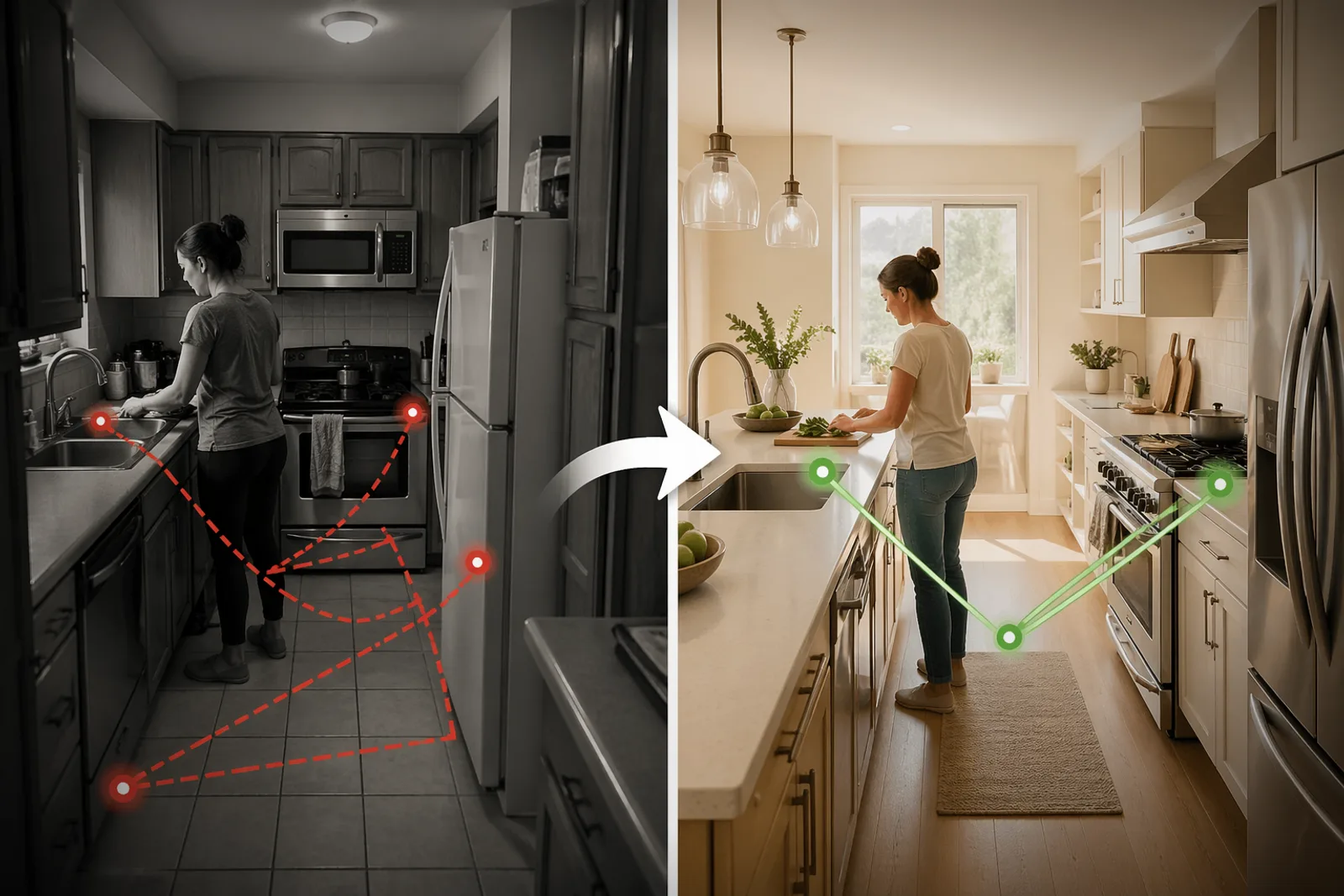
Your Kitchen Layout Is Costing You 40 Minutes a Day (Here's the Fix)
The work triangle isn't a design trend. It's the difference between a kitchen that flows and one that fights you.
The Problem You've Stopped Noticing
You've adapted to your kitchen. That's the insidious part.
"You've adapted to your kitchen. You've learned which drawer sticks, which counter is too far, which path forces you sideways. That adaptation is the insidious part — it hides a fixable problem."
You don't consciously notice that you walk 14 steps from the stove to the fridge every time you cook dinner. You've stopped registering that the dishwasher door blocks the pantry when it's open. You've internalized the awkward shuffle past the island that's six inches too close to the counter. It's just... your kitchen.
But add those micro-inefficiencies up across a year and the math is striking. Time-motion studies from Cornell's Food and Brand Lab show that the average home cook makes 120-150 trips across the kitchen during a single dinner preparation. In a poorly laid out kitchen, those trips add 30-45 minutes of wasted movement per day. That's 180-270 hours per year — the equivalent of more than a full work week — spent walking in circles in your own home.
The fix isn't a bigger kitchen. Most Houston homes don't have the square footage for that anyway. The fix is a smarter layout.
"The fix isn't a bigger kitchen — most Houston homes don't have the square footage for that anyway. The fix is a smarter layout."
The Work Triangle: Why a 70-Year-Old Idea Still Matters
The kitchen work triangle — the path between your sink, stove, and refrigerator — was developed in the 1940s by the University of Illinois School of Architecture. Eight decades later, it remains the single most reliable predictor of kitchen efficiency.
The rules are simple:
- Each leg of the triangle should be between 4 and 9 feet
- The total perimeter should be between 13 and 26 feet
- No major traffic path should cross through the triangle
- No cabinet or island should block any leg
Most builder-grade Houston kitchens violate at least two of these rules. The classic suburban layout puts the fridge in a corner 12 feet from the stove, forces you to walk around an island to reach the sink, and routes foot traffic from the garage directly through the cooking zone.
Work triangle audit: measure the three legs between your sink, stove, and fridge. Each leg should be 4-9 feet. Total perimeter should be 13-26 feet. No traffic path should cut through the triangle. If two or more rules are broken, a layout correction pays for itself in daily friction eliminated.
Here's what correcting these violations actually looks like in practice:
The galley-to-open conversion. Houston's 1980s-2000s homes love galley kitchens. They're space-efficient but terrible for flow — one cook blocks the entire kitchen. Opening one wall to the living or dining room and adding a peninsula creates a natural triangle with 5-7 foot legs. Cost: $8,000-$15,000 for wall removal, header, and finish work.
The island repositioning. Many Houston kitchens have an island that's centered for aesthetics rather than function. Moving it 18-24 inches in any direction can transform the triangle from a 28-foot slog to a 19-foot flow. Sometimes the most impactful renovation is moving something that's already there.
The zone approach. For larger kitchens, the triangle evolves into work zones: prep zone (sink + cutting surface + waste), cooking zone (range + spices + utensils), and storage zone (fridge + pantry + bulk items). Each zone should be self-contained — you shouldn't need to cross the kitchen for a spatula while something's sizzling.
Making It Yours: Where Identity Meets Layout
Here's where kitchen renovation gets personal — and where most contractors fall short.
A layout isn't just about efficiency metrics. It's about how YOUR family lives. The work triangle is universal, but the details inside it should reflect you:
The morning routine test. Walk through your typical Tuesday morning. Coffee first? Lunches for kids? Smoothie? Cereal? Where do those paths overlap and conflict? A great kitchen layout separates the coffee station from the lunch-prep zone so two people can operate simultaneously without doing the kitchen shuffle.
The entertaining question. Do you cook with friends in the room? Then the layout needs a social edge — a peninsula or island where guests can sit and talk without being in the splash zone. Do you cook solo and present? Then the kitchen can be more enclosed, optimized for one efficient operator.
The homework zone. Houston families increasingly use the kitchen as homework central. A 24-inch deep counter extension with barstools, positioned outside the work triangle but within conversation range, gives kids a landing spot that doesn't interfere with cooking.
At Craftwork, the design consultation isn't just about measurements. We ask how you actually use the room — morning, afternoon, evening, weekdays, weekends — and design the layout around your real patterns, not a floor plan template.
Decision Fatigue Is Real (And We've Solved It)
Here's the hidden barrier that kills more kitchen renovations than budget: choice paralysis.
When you start researching kitchen layouts, you'll find 50 configurations, 200 cabinet options, 30 countertop materials, 15 flooring types, and 8,000 tile patterns. Each decision spawns three more. By the time you've spent 40 hours on Pinterest and Houzz, you're more confused than when you started — and exhausted enough to either delay the project or default to whatever the contractor suggests.
This is where Craftwork's guided design process earns its keep:
Curated packages, not infinite menus. We present 3 layout options based on your specific kitchen dimensions and how you described your use patterns. Not 15. Three. Each one is a complete, buildable design with specific materials, hardware, and finish selections already coordinated.
Decision sequencing. Instead of making all choices simultaneously, we sequence decisions so each one narrows the next. Layout first (this determines cabinet count and placement). Then cabinet style (this determines hardware finish family). Then countertop (this determines backsplash tone range). Each decision makes the next one easier, not harder.
The "live with it" preview. Before finalizing, we create a detailed rendering showing your actual kitchen dimensions with the proposed layout. You see the island clearance, the triangle paths, the sight lines to the living room. Decisions feel less abstract when you can visualize Tuesday morning in the new space.
Real Numbers: What Layout Changes Cost in Houston
Here's what common layout modifications run:
- Island repositioning (no plumbing move): $3,000-$6,000. Fixes triangle, improves clearance.
- Wall removal (non-load-bearing): $5,000-$8,000. Opens galley, creates flow.
- Wall removal (load-bearing, with beam): $8,000-$15,000. Major transformation, structural work.
- Sink relocation (within 4 feet): $2,000-$4,000. Optimizes prep zone.
- Electrical repositioning (outlets + lighting): $1,500-$3,500. Supports new layout zones.
- Peninsula addition: $4,000-$8,000. Social edge + triangle anchor.
The highest-ROI layout change for most Houston kitchens? Opening a galley wall. The cost is modest relative to a full renovation, but the transformation — both in function and home value — is dramatic. Appraisers consistently rate open kitchen-to-living layouts higher than closed galley plans in the Houston market.
The Bottom Line
Your kitchen layout isn't a cosmetic choice. It's an operating system. And most Houston homes are running a 1990s operating system in a 2026 family.
"Your kitchen layout isn't a cosmetic choice. It's an operating system. And most Houston homes are running a 1990s operating system in a 2026 family."
The good news: you don't need to knock down walls to fix it. Sometimes it's moving an island. Sometimes it's relocating a sink. Sometimes it IS a wall removal — but even then, the cost is a fraction of a full renovation, and the daily impact is enormous.
At Craftwork, we design layouts around your life, not around a template. Because the best kitchen isn't the one that looks best on Instagram — it's the one where Tuesday morning actually works.
Ready to redesign how your kitchen flows? [Book a layout consultation →]
Sources: Cornell Food and Brand Lab kitchen efficiency studies, University of Illinois School of Architecture work triangle research, National Kitchen & Bath Association layout guidelines, Craftwork project data (Houston metro), Houston Association of Realtors appraisal comparables.