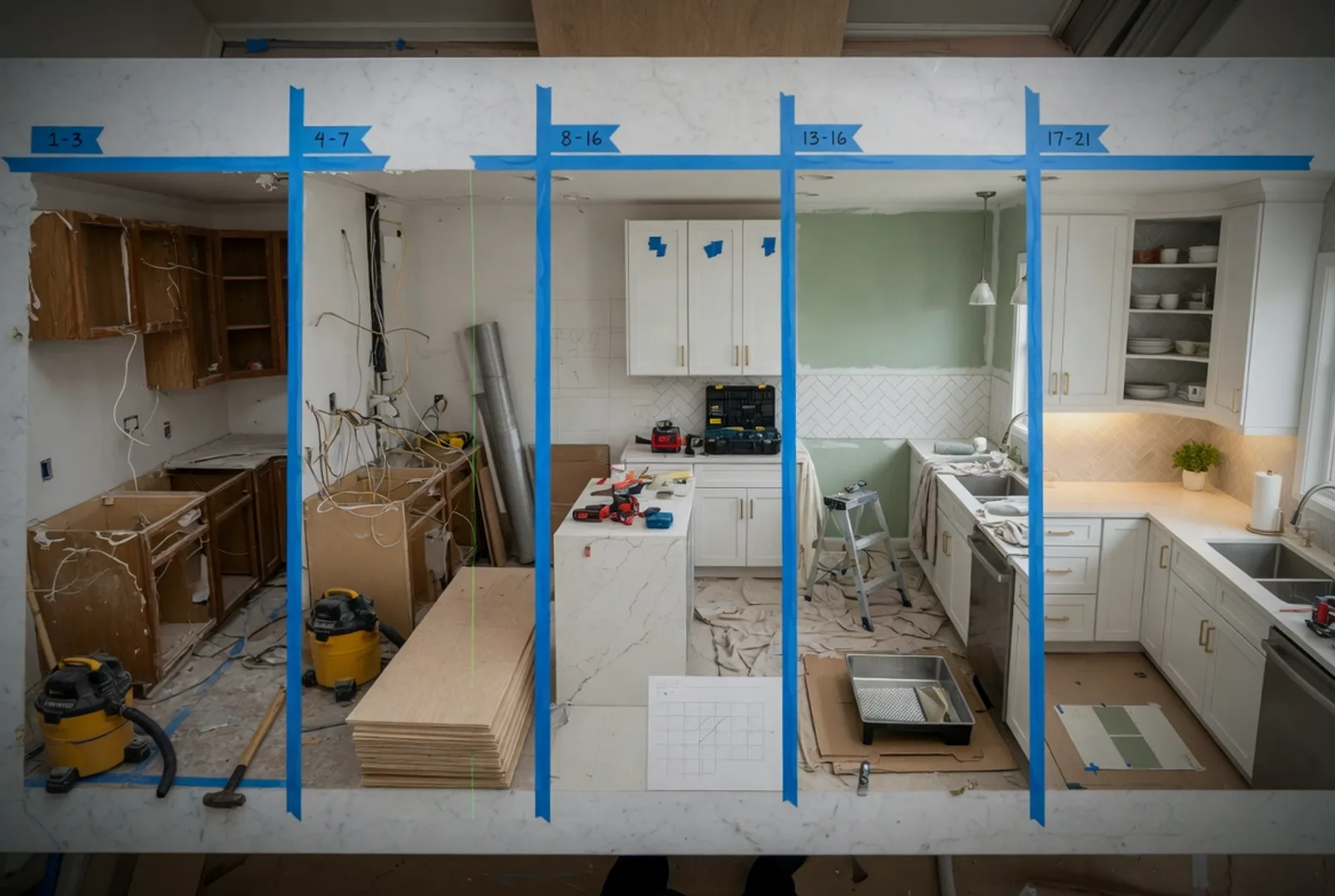
We Finished the Johnson Kitchen in 19 Days. Here's What Went Right (And the One Thing That Almost Didn't)
A real Craftwork project, broken down day by day — so you know exactly what to expect.
Why We're Telling This Story (Instead of Just Showing the Photos)
Every contractor has a portfolio page with beautiful before-and-after photos. They're easy to curate — shoot the "before" in bad lighting, shoot the "after" with a wide lens and a staged fruit bowl. You never see the middle.
But the middle is where trust is built or broken. The middle is the dusty Tuesday when the plumber finds a corroded pipe. The Thursday when the countertop template doesn't match the cabinet opening. The Monday morning when the client texts "are you still on schedule?" and actually gets an answer.
"The middle is where trust is built or broken. The finished photos don't show it, which is exactly why you should ask about it."
We're going to walk you through a real project — a kitchen renovation in the Heights area of Houston — from consultation to final walkthrough. Not the curated version. The real one.
The Setup: What the Johnsons Wanted
The Johnson family bought their Heights bungalow in 2019. Three bedrooms, one bathroom, and a galley kitchen that hadn't been touched since 1987. Laminate countertops, particle-board cabinets, a single overhead fluorescent light, and a layout that made cooking dinner feel like parallel parking. Their wishlist was specific and sensible:
- Open the galley wall to the dining room
- Caesarstone countertops (they'd done their research)
- Soft-close cabinetry with a pantry pullout system
- Under-cabinet lighting
- New flooring to match the rest of the house
- Budget of $42,000 to $48,000
Their fear, which they said out loud in the first meeting, was that their neighbor had hired a contractor last year and three months later the kitchen still wasn't done and they'd spent $20,000 over the estimate.
The Quote: How We Got to the Number
Our scoping visit took two and a half hours. We measured every wall, opened every cabinet, checked the electrical panel, photographed the plumbing connections, and looked at the load-bearing wall they wanted to open. The detailed findings drove the whole quote:
- The galley wall was not load-bearing, confirmed by structural assessment — saves $3,000 to $5,000 in beam work
- The electrical panel was 100 amps — fine for the kitchen, no upgrade needed
- Plumbing was copper and in good condition — no re-piping needed
- The subfloor was solid with no moisture damage
Fixed quote: $44,200. That included demolition, wall removal, framing, electrical (6 new circuits, 12 outlets, under-cabinet LED wiring), plumbing (sink relocation, dishwasher hookup), Caesarstone countertops, semi-custom cabinetry with Blum hardware, porcelain tile flooring, backsplash, paint, and a 7% contingency buffer. The Johnsons signed. Demo was scheduled for three weeks out.
Days 1 Through 4: Demolition, Structure, and Rough-In
Dust barriers went up on Day 0, the day before demo — plastic sheeting from ceiling to floor on every opening to the rest of the house. By end of Day 2, the old kitchen was down to studs. Cabinets, countertops, flooring, and the drywall on the galley wall were all removed. Debris hauled same day.
Days 3 and 4 handled structure and rough-in. Wall removal completed with a new header installed (even non-load-bearing walls need proper header framing when opened). Electrical rough-in ran new circuits back to the panel with outlet boxes placed per the final layout. Plumbing rough-in relocated the sink supply and drain 4 feet to the new island position.
Day 5: The Surprise That Defines a Contractor
During plumbing rough-in, our plumber found a 6-inch section of galvanized drain pipe hidden behind the original wall. It was corroded but not yet leaking. Left in place, it would have failed within 1 to 2 years — after the new kitchen was finished.
This is the moment that defines a contractor. A less scrupulous company would have left it, because it wasn't in the scope. A change-order company would have quoted $1,800 to replace it. We replaced it — copper-to-PVC transition, 30 minutes of labor, $180 in materials — covered by our contingency buffer. The Johnsons got a text with photos and an explanation. No invoice. No drama.
"A change order is what happens when a contractor decides an old problem is suddenly your problem. A contingency buffer is what happens when they decide it's theirs."
Days 6 Through 14: Drywall, Cabinets, Flooring
Days 6 and 7 were drywall and prep. New drywall hung, taped, and mudded. The opening between the kitchen and dining room was framed and finished. Primer went on every surface.
Days 8 through 10 were cabinet install. Semi-custom cabinets installed and leveled. This is where Houston foundation knowledge matters. The floor had a three-eighths-inch slope across 12 feet, typical for Heights homes on pier-and-beam. Our lead shimmed every cabinet individually to achieve level, rather than trusting the floor to be flat. The pantry pullout system went in. Blum soft-close hardware on every door and drawer.
Days 11 and 12 handled the countertop template and electrical finish. The Caesarstone fabricator templated on Day 11. All outlets and switches were installed. Under-cabinet LED strips wired and tested.
Days 13 and 14 were flooring. Porcelain tile installed throughout the kitchen and into the dining room transition, with proper underlayment, expansion gaps at walls, and matched grout color.
Ask any Heights or pier-and-beam contractor how they handle cabinet installation on a sloped floor. If the answer isn't "shim every cabinet individually to level," keep interviewing. A trusting-the-floor install will show cracked caulk joints inside a year.
Days 15 Through 19: Countertops, Backsplash, Finish
Day 15 was countertop install day. Caesarstone fabricated to template and installed with precision. Sink cutout and undermount installed same day.
Days 16 and 17 were backsplash and plumbing finish. Tile backsplash installed. Sink connected, dishwasher hooked up, disposal installed. All plumbing tested under pressure.
Days 18 and 19 were paint, hardware, and punch list. Final coat of paint. Cabinet hardware installed. All touch-ups completed. Thorough cleaning of the entire kitchen and affected rooms. Dust barriers removed. Final walkthrough with the Johnsons.
Day 19 total: $44,200 spent. $44,200 quoted.
The Numbers That Matter
A case study without numbers is just a testimonial. Here's how this project compares to Houston industry averages for a kitchen of this scope:
- Timeline — 19 working days versus the Houston average of 30 to 45 working days
- Budget variance — $0 on a fixed quote versus the average 23 to 35% over estimate
- Change orders — zero versus the average of 2 to 4
- Communication gaps — zero (daily updates) versus the typical "I'll get back to you"
- Surprise costs to the client — $0 versus the average of $3,000 to $8,000
The Johnsons' home appraised $32,000 higher at their next refinance — a 72% return on a $44,200 investment. The kitchen they use every day cost less than their neighbor's unfinished one.
The Contrast: What Could Have Happened
Without naming names, here's what the neighbor's project looked like from the same starting point:
- Estimate — $38,000
- Change order one (subfloor damage) — plus $4,200
- Change order two (electrical panel upgrade) — plus $6,800
- Change order three (backordered cabinets, substitution needed) — plus $2,100
- Timeline — 14 weeks actual versus 6 weeks quoted
- Final cost — $51,100, 34% over the original estimate
- Communication — "He stopped returning calls around week 8"
"The cheaper contractor cost $6,900 more. Took 4 times longer. And the experience was miserable. Price is what you pay. The rest is what it costs you."
The "cheaper" contractor cost $6,900 more. Took four times longer. And the experience was miserable.
The Bottom Line
A case study without numbers is just a testimonial. And a testimonial without process transparency is just marketing.
At Craftwork, we share the real timeline, the real budget, the real surprises — because that's what it looks like when a renovation goes right. Not perfect. Right. The pipe was corroded. The floor wasn't level. Those aren't failures. They're Tuesday in Houston construction. The difference is how you handle them.
Ready to see your project mapped out like this? Book a scoping visit and we'll walk your kitchen, identify the hidden variables specific to your house, and come back with a fixed quote you can actually plan against.