Your Kitchen Is Raising Your Cortisol (The Neuroscience Nobody Mentions at the Showroom)
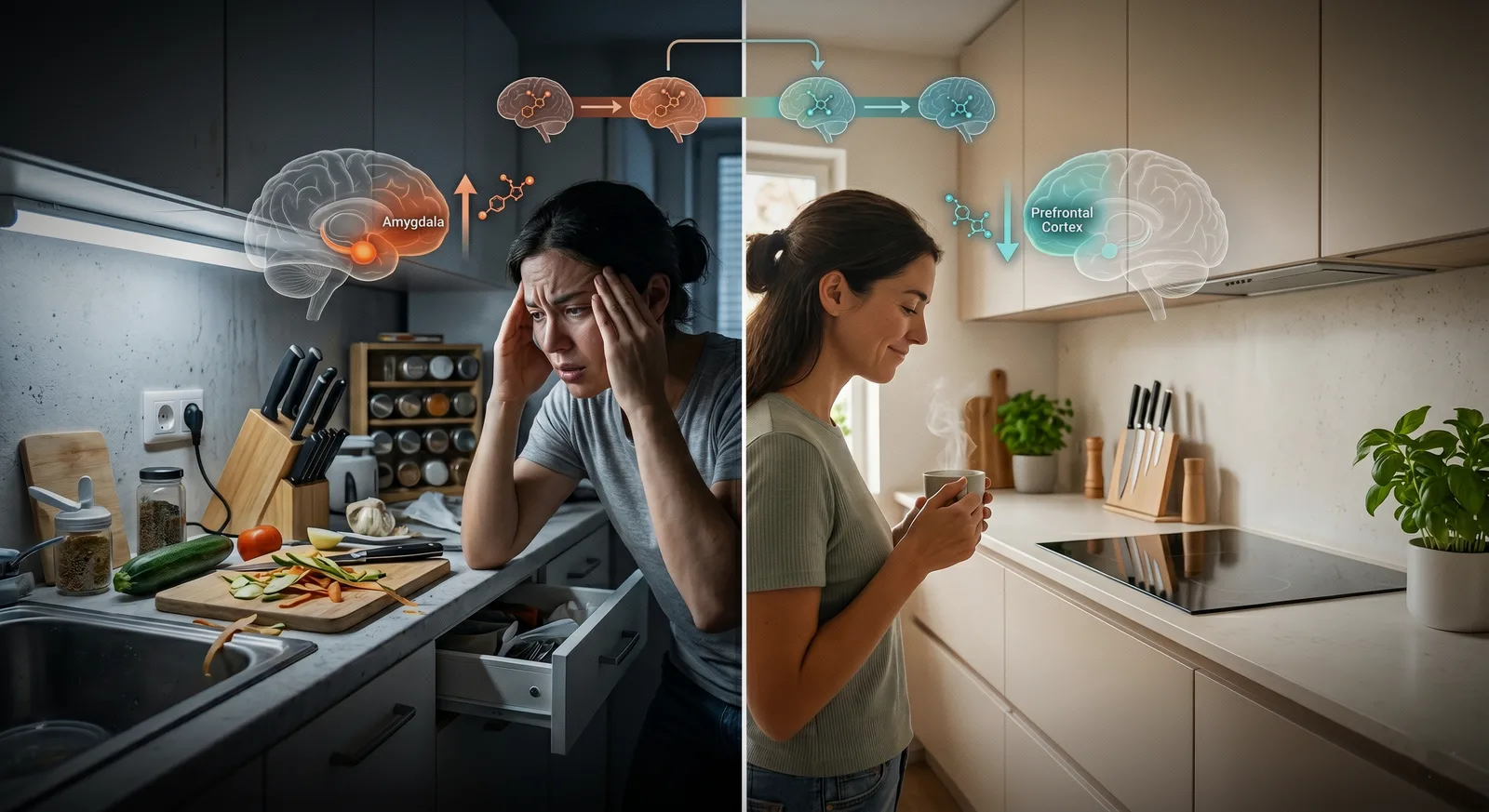
The best argument for renovating isn't on Pinterest. It's in a UCLA study of 32 dual-income families.
The Study That Should Have Changed Kitchen Design
In 2010, two researchers from UCLA's Center on Everyday Lives of Families published a study that tracked 30 middle-class dual-income couples through their home routines. They measured salivary cortisol — the body's primary stress hormone — across the day.
One finding jumped out. Women whose homes were described as "cluttered" or "unfinished" had significantly flatter cortisol rhythms than women whose homes were described as "restful" or "restorative."
A flat cortisol rhythm is not a good thing. A healthy rhythm spikes in the morning and gradually falls through the evening. A flattened rhythm means your body is in low-grade stress mode all day. It's correlated with worse sleep, higher depression risk, and faster metabolic aging.
The study authors (Saxbe and Repetti) were careful not to claim causation. Clutter might cause stress, stress might cause clutter, both might share a third cause. But the correlation was large and statistically robust — and the room where it showed up most consistently was the kitchen.
"Your kitchen isn't ugly or dated. If the person who uses it most stands in it two hours a day, it's measurably raising their baseline cortisol. That's not metaphor. That's salivary data."
Cognitive Load From Disorganization
When homeowners think about renovating, they usually think about how the kitchen looks. But the neuroscience says the bigger problem is how it works, and specifically how it makes you feel after the fifteenth time you've used it this week. The first pathway is cognitive load.
Every time you reach for a pot lid and have to search through a pile, you're burning a small amount of executive function. Do this 40 times a day and you've spent real mental energy on nothing. Kathleen Vohs's research on decision fatigue (Journal of Personality and Social Psychology, 2008) showed that trivial repeated decisions deplete willpower measurably — and people with depleted willpower make worse choices about food, conflict, and work for hours afterward.
Circadian Disruption From Overhead Lighting
Standard kitchen ceiling lights are usually 4000K or 5000K — cool white, similar to office fluorescents. When you turn them on at 7 PM to make dinner, you're telling your body's circadian system it's midday.
A 2011 Harvard study (Gooley et al.) found that room-level light exposure for 8 hours before bedtime suppressed melatonin production by more than 50%. Half your body's sleep hormone, gone, because of the kitchen lighting choice you inherited from a builder in 1998.
Acoustic Stress From Hard Surfaces
Kitchens full of tile, quartz, and bare cabinet fronts are acoustically "live." Every sound reverberates. A running dishwasher plus a conversation plus a TV in the next room becomes a wall of noise.
Research on open-plan office acoustics (Lee and Aletta, Applied Acoustics 2019) has consistently shown that sustained reverberation above roughly 0.6 seconds increases heart rate and subjective stress. Your kitchen might be louder than the noisiest office you've ever worked in.
Spatial Constraint in Work Zones
The fourth pathway is spatial. If the sink-stove-fridge triangle overlaps the walking path, every meal prep involves a low-grade navigation problem. Your brain handles navigation as a constant background task; when that task is harder than it should be, it eats cognitive resources that would otherwise be free.
NKBA kitchen design guidelines specify a 42-inch minimum clearance for the primary work aisle for exactly this reason. Anything narrower is measurably harder to use.
None of these four pathways is individually catastrophic. Together, for someone who uses the kitchen two to three hours a day, they add up to a chronic low-grade tax on the person doing the cooking. Usually the woman of the house, per the UCLA study. Usually uncomplained-about, because it feels silly to complain about "the kitchen makes me tired." It doesn't feel silly once you see the data.
The Decision-Fatigue Kitchen
Here's a reframe that changes how people think about renovation priorities. A kitchen is a decision environment. Every interaction with it is either adding load or removing load. Here's what the load-adding version looks like:
- 200 items visible on countertops because there's nowhere to put them
- Overstuffed cabinets that require rummaging to find anything
- Appliances stacked on top of appliances because there's no dedicated home
- A drinking glass chosen from a crowded cabinet every morning
- No "default" anything — every task requires a decision
"A kitchen is a decision environment. Every interaction is either adding load or removing load. Most builder kitchens are adding it."
The Decision-Light Kitchen
The alternative is a kitchen where 80% of the load has been engineered out by design. It looks like this:
- Hidden storage for 80% of daily items, visible storage only for the 20% you use constantly
- Dedicated zones — coffee zone, prep zone, bake zone, pack-lunches zone
- Appliance garages for the toaster, blender, and stand mixer
- The glassware cabinet directly above the filtered water
- Obvious defaults — knives live here, cutting boards live there, dish towels are always in this drawer
The second kitchen doesn't make you a better person. It makes your brain a better environment for the person you already are. You stop burning willpower on low-value micro-decisions and have more left for the things that actually matter.
Priority 1: Intentional Storage Architecture
If we take the research seriously, a kitchen renovation designed around stress reduction (not just aesthetics) has three priorities, in order. The first is storage architecture — the single highest-impact move and the one that's almost always under-spec'd. A well-designed Houston kitchen includes:
- Deep drawer banks for pots and pans, not shelves — drawers let you see everything from above
- Vertical dividers for sheet pans, cutting boards, and baking trays
- A dedicated appliance garage or pull-out countertop
- Pull-out pantry towers that expose everything at a glance
- Soft-close Blum hardware throughout — the small noise of a slamming drawer is itself a cortisol signal
Blum soft-close hardware is now standard in 60 to 65% of designer kitchens, and the reason isn't luxury. It's mechanical stress reduction. Every slam is a micro-cortisol signal, and eliminating them is cheaper than any other intervention per unit of daily experience.
Priority 2: Layered 2700K Lighting on Dimmers
Rip out the overhead fluorescent. Install three lighting circuits, each on its own dimmer, all 2700K. The three layers and what each does:
- Ambient — recessed cans, dimmable, evenly distributed for general illumination
- Task — pendants over the island and under-cabinet LEDs for prep and cooking surfaces
- Accent — toe-kick LEDs or inside-cabinet lights on a separate dimmer for evening mood
The entire upgrade costs $1,800 to $2,800 with fixtures and electrician labor. It is the single best ROI move for kitchen stress reduction. You will notice it within the first three nights.
If budget forces you to pick one cortisol intervention, pick the lighting overhaul. It's under $3K installed, the circadian impact is immediate, and it costs roughly what you'd spend on one "statement" pendant at a high-end showroom.
Priority 3: Materials That Don't Reverberate
The third priority is acoustic. Large-format porcelain tile (fewer grout lines, quieter to walk on) over small mosaic. Fabric-upholstered bar stools instead of metal. Open dining areas that include soft textiles — a rug, curtains. Solid-core cabinet doors, which are heavier and quieter than hollow-core.
These small moves drop the acoustic reverberation time from roughly 1.2 seconds in a typical builder kitchen to roughly 0.5 seconds in a properly considered kitchen. That's the difference between a room that exhausts you at hour two and a room that stays easy at hour six.
The Island That Actually Matters
89% of homeowners say they want a kitchen island (NAHB Remodeling Impact Report). The median existing Houston kitchen island is 4 by 7 feet. The standard designer specification is 4 by 8 or 5 by 8. That extra two feet of length is where the entertaining, the homework, the mail sorting, and the Tuesday-morning cereal all happen.
But the island that matters for cortisol isn't about length. It's about what's under it. A decision-fatigue island has shelves. A decision-light island has drawer banks. Shelves require you to bend, move things around, and excavate for what you want. Drawers let you see everything from above, grab what you need, and close it. Over a year, the difference in small daily friction is enormous.
At Craftwork, every kitchen we design defaults to drawer-base cabinetry around the island. Not because it's trendy — because it's measurably less exhausting to use.
The Three-Tier Choice Architecture
Decision fatigue research applies to the renovation process itself, not just the finished kitchen. If your contractor hands you 200 cabinet samples and asks you to pick, they're offloading decision work onto the exact person the project is supposed to be serving.
A well-run design process should limit your choice space per category to three curated options. Chernev's meta-analysis (2015, N=7,202 across 99 choice studies) found that beyond about seven options, satisfaction drops and decision quality drops. Three is the Goldilocks zone.
Craftwork's Good/Better/Best tier system is built around this. For each material decision — countertop, cabinets, tile, hardware, lighting — you pick a tier. We handle procurement inside that tier. You spend your decision budget on the two or three categories you actually care about and let us handle the rest. The finished kitchen looks identical to one where you spent 40 hours in showrooms, except you didn't have to spend 40 hours in showrooms.
This isn't just convenience. It's decision-environment design applied to the renovation process itself.
The Bottom Line
Your kitchen is not an interior design problem. It's a neuroscience problem. The UCLA data says the person who uses it most is carrying measurable biological load from it. The Harvard data says the lighting is wrecking their sleep. The choice-overload research says the visible clutter is eating their executive function.
A renovation designed around these facts — storage-first, lighting-second, materials-third — costs roughly what a renovation designed around looking good costs. Usually $35,000 to $55,000 for a mid-grade Houston kitchen. The difference is what you get in return. A pretty kitchen is valuable. A kitchen that lowers your daily baseline stress is more valuable. The good news is you don't have to pick — a properly designed renovation delivers both.
"The goal isn't a magazine photo. The goal is a room the person standing in it at 7 PM on a Tuesday actually wants to be in."
At Craftwork, we bring this frame to every consultation. We ask how you actually use the space, who uses it most, when it feels hardest, and what the evening routine looks like. Then we design around the answers.
Ready to design a kitchen your nervous system will thank you for? Book a cortisol-conscious kitchen consultation and we'll walk your space, map the decision loads you're currently carrying, and design them out.