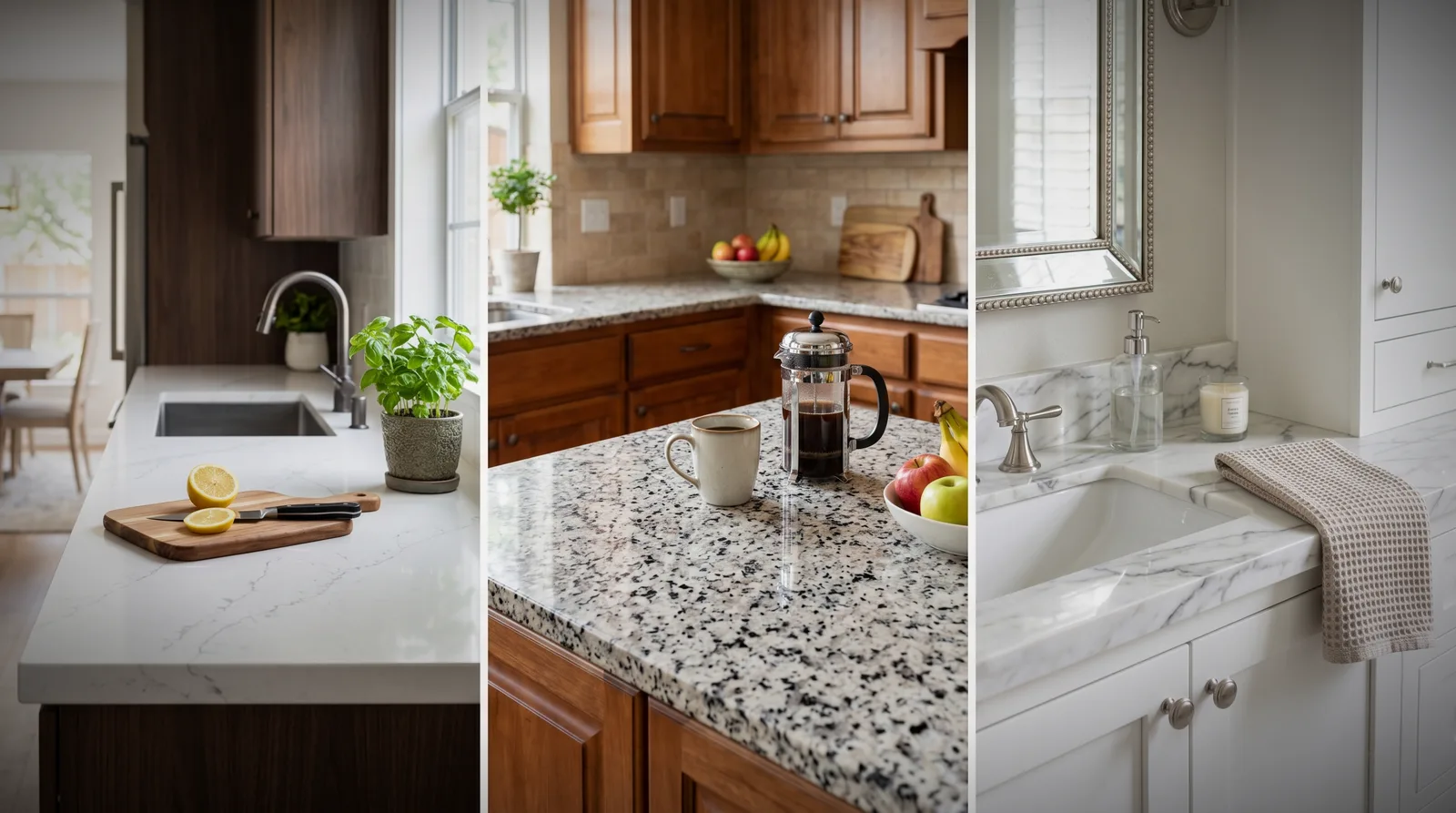
Caesarstone vs. Granite vs. Marble — The Houston Homeowner's No-BS Guide to Countertops
The surface you choose determines whether your kitchen looks great in 10 years or needs replacing in 5.
Why This Decision Matters More Than You Think
Your countertop is the most touched, most seen, and most abused surface in your home. It handles knife cuts, hot pans, spilled wine, homework assignments, grocery bags, and the occasional toddler who climbs onto it. It needs to look beautiful at the open house in 2036 while surviving everything your family throws at it between now and then.
Yet most homeowners choose countertops the way they choose paint colors — by looking at samples in a showroom under perfect lighting and picking the one that matches their Pinterest board. That's how you end up with a material that photographs well but performs terribly.
Here's what the material science actually says, stripped of showroom marketing and Instagram filters.
"Here's what the material science actually says, stripped of showroom marketing and Instagram filters."
The Big Three: An Honest Comparison
Engineered Quartz (Caesarstone, Silestone, Cambria)
What it is: Ground natural quartz (93-95%) bound with polymer resins and pigments. Manufactured in slabs to precise specifications.
Why we install it in 85% of Craftwork kitchens:
- Hardness: 7 on the Mohs scale (granite is 6-7, marble is 3-4). It resists scratches from knives, keys, and the daily abrasion of normal kitchen use.
- Stain resistance: Non-porous surface means red wine, coffee, turmeric, and lemon juice wipe off with a damp cloth. No sealing required. Ever.
- Consistency: Because it's manufactured, the pattern and color are uniform across slabs. No "natural variation" surprises where the installed countertop looks different from the sample.
- Warranty: Caesarstone carries a 15-year residential warranty. Try getting that from a natural stone quarry.
Cost in Houston: $55-$85/sq ft installed, depending on edge profile and color selection. A typical 40 sq ft kitchen: $2,200-$3,400.
The honest downside: Engineered quartz can discolor under sustained UV exposure (outdoor kitchens are out). It can also scorch — a hot pan directly from the oven will leave a mark. Use trivets. Not a design limitation; just a use habit.
Granite
What it is: Natural igneous rock, quarried in slabs and polished. Each slab is unique.
Where it makes sense: Granite was the gold standard for 20 years and remains a solid choice — literally. It's extremely hard, heat-resistant (granite won't scorch), and available in hundreds of natural patterns.
Where it falls short:
- Porosity: Granite is naturally porous. It requires professional sealing every 1-2 years. Skip the sealing and you'll see stains around the sink area within 18 months — especially in Houston's humidity.
- Inconsistency: The slab you approved at the stone yard may look different from the section that ends up as your kitchen island. Natural variation is the selling point AND the risk.
- Maintenance reality: Despite being "low maintenance" in marketing, granite requires more ongoing care than quartz. Acidic foods (lemon, tomato, vinegar) can etch unsealed areas.
Cost in Houston: $40-$100/sq ft installed, with huge variation by stone grade. A typical 40 sq ft kitchen: $1,600-$4,000. Budget granite can be cheaper than quartz; premium granite rivals it.
Marble
What it is: Metamorphic limestone, prized for its veining and luminosity. The most beautiful — and the most temperamental — of the big three.
The uncomfortable truth:
Marble is a 3-4 on the Mohs hardness scale. For context, a copper penny is 3.5. Your kitchen knife blade is 5.5-6.5. This means marble scratches easily, etches from any acid (including common foods), stains if not sealed religiously, and develops a patina over time that some people love and others call "damage."
Marble is stunning in a bathroom vanity that gets light use. In a kitchen that cooks dinner five nights a week? It's a maintenance commitment most Houston families underestimate.
"Marble is stunning in a bathroom vanity. In a kitchen that cooks dinner five nights a week, it's a maintenance commitment most Houston families underestimate."
Cost in Houston: $75-$200/sq ft installed. A typical 40 sq ft kitchen: $3,000-$8,000. And that's before the annual resealing ($200-$400/visit) and eventual honing/repolishing ($500-$1,000) to address etching.
The 10-Year Cost Comparison
This is where the "expensive" material stops looking expensive:
- Caesarstone Quartz: $2,800 install, $0 annual sealing, $0 ten-year maintenance, rare repairs ($0). 10-year total: $2,800. 15-year warranty.
- Granite (mid-grade): $2,400 install, $150-$300/yr sealing, $1,500-$3,000 ten-year maintenance, occasional repairs ($500). 10-year total: $4,400-$5,900. Warranty varies (often none).
- Marble: $5,200 install, $200-$400/yr sealing, $2,000-$4,000 ten-year maintenance, likely repairs ($1,000-$2,000). 10-year total: $8,200-$11,200. No warranty.
The "affordable" granite costs 57-110% more over a decade. The "premium" marble costs 193-300% more. And that's before factoring in the equity impact: buyers overwhelmingly prefer quartz over granite in the Houston resale market (according to HAR listing data from 2024-2026).
Beyond Countertops: The Materials That Matter Behind the Scenes
The countertop gets all the attention, but three other material decisions have outsized impact on your kitchen's longevity:
Cabinet hardware: Blum vs. generic. A Blum Tandembox drawer system ($80-$120/drawer) glides on precision bearings rated for 50,000+ cycles. A generic soft-close system ($20-$40/drawer) uses plastic guides that wear out in 3-5 years. You open your most-used drawer 8-10 times daily. Do the math: 3,000+ cycles per year. Blum hardware outlasts the cabinet itself. Generic hardware becomes the thing you apologize for when guests open the silverware drawer.
Cabinet boxes: Plywood vs. particleboard. Plywood cabinet boxes resist moisture, hold screws indefinitely, and don't swell. Particleboard (often marketed as "furniture board") swells when exposed to moisture — and in Houston, under-sink cabinets WILL encounter moisture. The price difference is $50-$100 per cabinet. For a 20-cabinet kitchen, that's $1,000-$2,000 total — insurance against cabinets that disintegrate from the bottom up.
Backsplash substrate: Cement board vs. drywall. Even in kitchens, the wall behind your backsplash matters. Cement board behind tile in splash-prone areas (behind the sink, behind the stove) prevents moisture migration that leads to mold and tile delamination. It's a $200-$400 upgrade that prevents a $2,000 repair.
The HGTV Price Recalibration
Here's the reframe that changes how you budget: the middle market gets the same materials as luxury.
A $45,000 Craftwork kitchen uses the same Caesarstone quartz as a $120,000 designer kitchen. The same Blum hardware. The same quality porcelain tile. The difference isn't in the materials — it's in the markup.
Luxury contractors charge $150-$250/hour for installation labor that costs $45-$65/hour. They add design fees (15-20% of project cost), procurement fees (10-15% markup on materials beyond wholesale), and project management fees (another 10-15%). By the time those layers stack up, the same Caesarstone countertop costs twice as much to install.
At Craftwork, you pay for the material, the labor, and a fair margin. No phantom fees. No luxury tax. The stone is the same stone.
"At Craftwork, you pay for the material, the labor, and a fair margin. No phantom fees. No luxury tax. The stone is the same stone."
The Bottom Line
Material selection isn't about choosing the most expensive option or the cheapest one. It's about matching the material to how you actually use the space, what Houston's climate demands, and what makes financial sense over a decade — not just on installation day.
Caesarstone quartz is our default recommendation for Houston kitchens because the math is unambiguous: lower lifetime cost, zero maintenance, superior stain resistance, and strong resale value. But the decision is yours — and at Craftwork, we'll walk you through the real data, not the showroom pitch.
When evaluating any countertop, ask three things: What's the water absorption rate? Does it require sealing — and how often? What does the warranty actually cover? Caesarstone answers all three with hard numbers. Ask every option to do the same.
Ready to pick your materials with real numbers, not guesswork? [Schedule a material consultation →]
Sources: Mohs Hardness Scale, Caesarstone technical specifications, Natural Stone Institute maintenance guidelines, BLS Producer Price Index for construction materials (2020-2026), Houston Association of Realtors listing data (2024-2026), Craftwork project cost database.