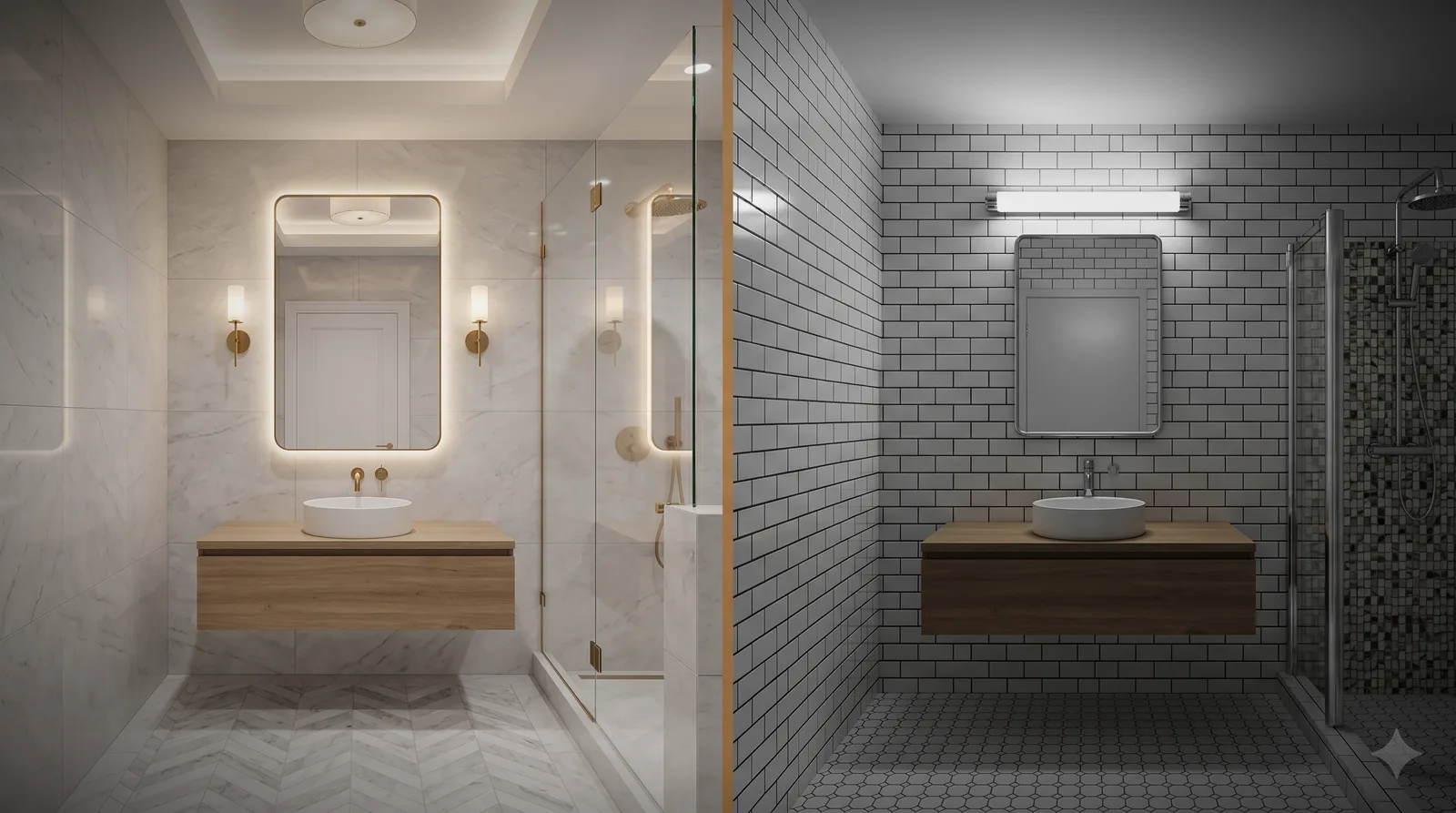
The Tile and Lighting Mistakes That Make $15K Bathrooms Look Like $5K Ones
Two decisions control 80% of how your bathroom feels. Here's how to get them both right.
The Two Decisions That Define Your Bathroom
After the waterproofing is done and the fixtures are chosen, two decisions remain that will determine whether your bathroom feels like a spa or a gas station restroom. Tile and lighting.
These aren't decorative afterthoughts. They're the visual and atmospheric foundation of the room. A bathroom with perfect plumbing, quality fixtures, and excellent waterproofing will still feel cheap if the tile is wrong and the lighting is harsh. Conversely, smart tile and lighting choices can make a moderately budgeted bathroom feel like a boutique hotel.
The problem is that most homeowners make these decisions backward. They pick the tile first, based on a Pinterest photo shot in perfect studio lighting, and then add lighting as an afterthought, whatever the electrician suggests. The result is a tile that looks different in their bathroom than it did online, and lighting that makes their skin look green at 6 AM.
Here's how to get both right — starting with the science that nobody at the tile showroom will tell you.
Porcelain vs. Ceramic: The Distinction That Actually Matters
Every tile showroom employee will tell you the difference between porcelain and ceramic. Most of them get it wrong. Both materials are made from clay fired in a kiln. The difference is the clay composition and the firing temperature:
- Ceramic tile uses standard clay, fired at 1,000 to 1,100 degrees Celsius, with a water absorption rate of 3 to 7% — suitable for walls and light-duty floors only
- Porcelain tile uses denser, feldspar-enriched clay, fired at 1,200 to 1,400 degrees Celsius, with a water absorption rate under 0.5% — suitable for all applications including wet areas and high-traffic floors
In Houston bathrooms, porcelain is the only correct choice for floors and shower walls. The sub-0.5% absorption rate means moisture doesn't penetrate the tile body — critical in a room that generates steam twice a day at 75 to 80% ambient humidity. Ceramic tile on a shower floor will absorb moisture through the body, not just the grout, eventually leading to mold growth underneath the tile that's invisible until the tile loosens.
The cost difference is small. Porcelain runs $4 to $15 per square foot versus ceramic at $2 to $8. For a 100 square foot master bathroom (floor plus shower walls), the premium is $200 to $700. That's insurance against a $3,000 tear-out-and-redo when ceramic fails in a wet environment.
Large-Format Tile: Fewer Grout Lines, Cleaner Look
The single biggest visual upgrade in bathroom tile over the last five years isn't a color or a pattern. It's size. Large-format tiles at 12 by 24 inches, 24 by 24 inches, or larger have transformed bathroom aesthetics because they dramatically reduce grout lines. Why grout lines matter more than most people realize:
- Maintenance — grout is porous, and even sealed grout absorbs moisture, stains, and develops discoloration over time, so fewer grout lines mean less maintenance
- Visual continuity — a wall of 3 by 6 inch subway tile has grout lines every 3 inches, while a wall of 12 by 24 inch tile has grout lines every 12 inches, creating a cleaner and more expansive visual field that makes the bathroom feel bigger
- Modern perception — Houston buyers and appraisers associate large-format tile with contemporary high-end design, making it one of the simplest ways to make a bathroom read as "renovated" rather than "updated"
Always specify rectified tile. Rectified tiles are precision-cut after firing to exact dimensions, allowing grout lines as thin as 1/16 inch. Non-rectified tiles require 1/8 inch minimum grout lines and undercut the whole point of going large-format. The 10 to 20% premium is worth it every time.
Our standard at Craftwork is 12 by 24 inch rectified porcelain on all walls, with a coordinated mosaic or smaller-format accent tile in niches and as the shower floor, where smaller tiles conform better to the drain slope. The brands we specify — Marazzi, Daltile, and Emser — all offer extensive large-format lines with Houston-warehouse availability.
The Shower Floor Exception
Shower floors require smaller tiles (2 by 2 inch or hexagonal mosaic) because the floor must slope toward the drain at a quarter-inch per foot. Large-format tiles can't conform to this slope without lippage — uneven edges where adjacent tiles meet at slightly different heights. The mosaic format flexes with the substrate, maintaining a smooth walking surface while achieving proper drainage.
The trick is to use the same porcelain family for your walls and shower floor. Most quality lines offer a matching mosaic that coordinates with the large-format wall tile — same color, same texture, scaled down. This keeps the bathroom visually cohesive while respecting the functional requirement.
Color Temperature: The Single Most Important Number in Bathroom Lighting
Every light bulb has a color temperature measured in Kelvin. This number determines whether your bathroom feels like a spa or an interrogation room:
- 2700K (warm white) — golden, warm tone, flattering to skin, creates a relaxed intimate atmosphere, the color temperature of a luxury hotel bathroom
- 3000K (soft white) — slightly cooler but still warm, good for task lighting where you need to see accurately without harshness, works well for vanity mirrors
- 4000K (cool white) — blue-white tone, clinical, makes skin look washed out, the color temperature of a hospital or office bathroom
- 5000K and above (daylight) — harsh blue, shows every pore, every blemish, every shadow
"Nobody looks good in 5000K. Nobody. Restaurants use 2700K exclusively, and that's why you look better in a restaurant bathroom than in your own."
Craftwork's standard is 2700K for ambient overhead lighting and 3000K for vanity task lighting. Never above 3000K in any bathroom application. Most builder-grade Houston bathrooms have a single 4000K flush-mount fixture on the ceiling. That's why you look terrible in your bathroom mirror and great in restaurant bathrooms.
The Three-Layer Lighting System
A well-lit bathroom uses three layers of light, each serving a different purpose. Skip any one of these and the room feels flat or harsh; use all three and it reads as designed.
Layer one is ambient light — general illumination from recessed LED downlights (4-inch cans) at 2700K, positioned to wash the room evenly without creating harsh shadows. For a standard master bathroom, that's three to four recessed fixtures on a dimmer. The dimmer is essential. Full brightness for cleaning, 40% for a relaxing evening shower.
Layer two is task light — vertical sconces flanking the mirror, not an overhead bar light. Side-mounted sconces at 3000K eliminate the under-eye shadows that overhead vanity lights create. This is the lighting you use to shave, apply makeup, or check your teeth. It needs to be accurate without being unflattering.
Side-mounted sconces, not overhead bar lights. An overhead bar casts downward shadows that accentuate under-eye circles and create unflattering contrast. Side-mounted sconces at eye level illuminate the face evenly — the same principle film cinematographers use. This isn't aesthetic preference, it's optical physics.
Layer three is accent light — LED strip lighting under a floating vanity, inside a shower niche, or as a toe-kick light. At 2700K on a dimmer, accent lighting transforms the bathroom from "functional room" to "designed space." The cost runs $100 to $300 for LED strips and a low-voltage driver. The impact is disproportionate.
Every Circuit on a Dimmer
Every lighting circuit in your bathroom should be on a dimmer. Full stop. The math is obvious once you see it:
- Dimmer switch cost — $30 to $60 each, with Lutron Caseta or Maestro the brands worth using
- Electrician labor — $50 to $100 per switch to install
- Total for three circuits — $240 to $480
For under $500, you gain complete control over your bathroom's atmosphere. Morning routine at 80% brightness. Evening bath at 30%. Middle-of-the-night trip at 10%. The same fixtures that help you see clearly at dawn create a spa atmosphere at sunset.
"The tile you choose determines the lighting you need, and the lighting you choose determines how the tile looks. Separating those decisions is why so many renovated bathrooms look "fine" instead of "beautiful.""
Making It Yours: Where Identity Meets Finish Selection
This is the stage where your bathroom stops being a renovation and becomes your bathroom. Three specific moves deliver the most personality per dollar:
- The accent wall — one wall, typically behind the vanity or the back of the shower, in a contrasting tile creates a focal point without overwhelming the space, especially in a horizontal stack-bond pattern that reads as intentional design
- The niche as jewelry — a contrasting mosaic tile inside the recessed shower niche (metallic, patterned, or textured) draws the eye and adds personality to an otherwise functional element, at a cost premium of $50 to $150 for real visual impact
- The hardware finish story — cool-toned tiles (whites, grays, blues) pair with chrome or brushed nickel, while warm-toned tiles (beiges, taupes, creams) pair with brushed gold or matte black, and consistency across every fixture and accessory creates the designer look that people feel but can't articulate
At Craftwork, we present tile and lighting as a combined decision — because they are. The tile you choose determines the lighting you need, and the lighting you choose determines how the tile looks. Separating these decisions, as most contractors do, is why so many renovated bathrooms look "fine" instead of "beautiful."
The Bottom Line
Tile and lighting are where most bathroom renovations leave money on the table — not by overspending, but by choosing wrong. The right porcelain tile at $8 per square foot outperforms the wrong marble at $40 per square foot. The right $30 dimmer switch outperforms the wrong $200 fixture.
At Craftwork, we approach tile and lighting as a system, not a shopping list. The tile, the grout, the layout pattern, the lighting color temperature, the dimmer levels, and the accent strategy are all designed together — because that's how they're experienced together.
Ready to design the bathroom you actually want to be in every morning? Book a design consultation and we'll walk your space, specify the tile and the lighting as one integrated decision, and show you exactly how the room will feel at 6 AM and 10 PM.