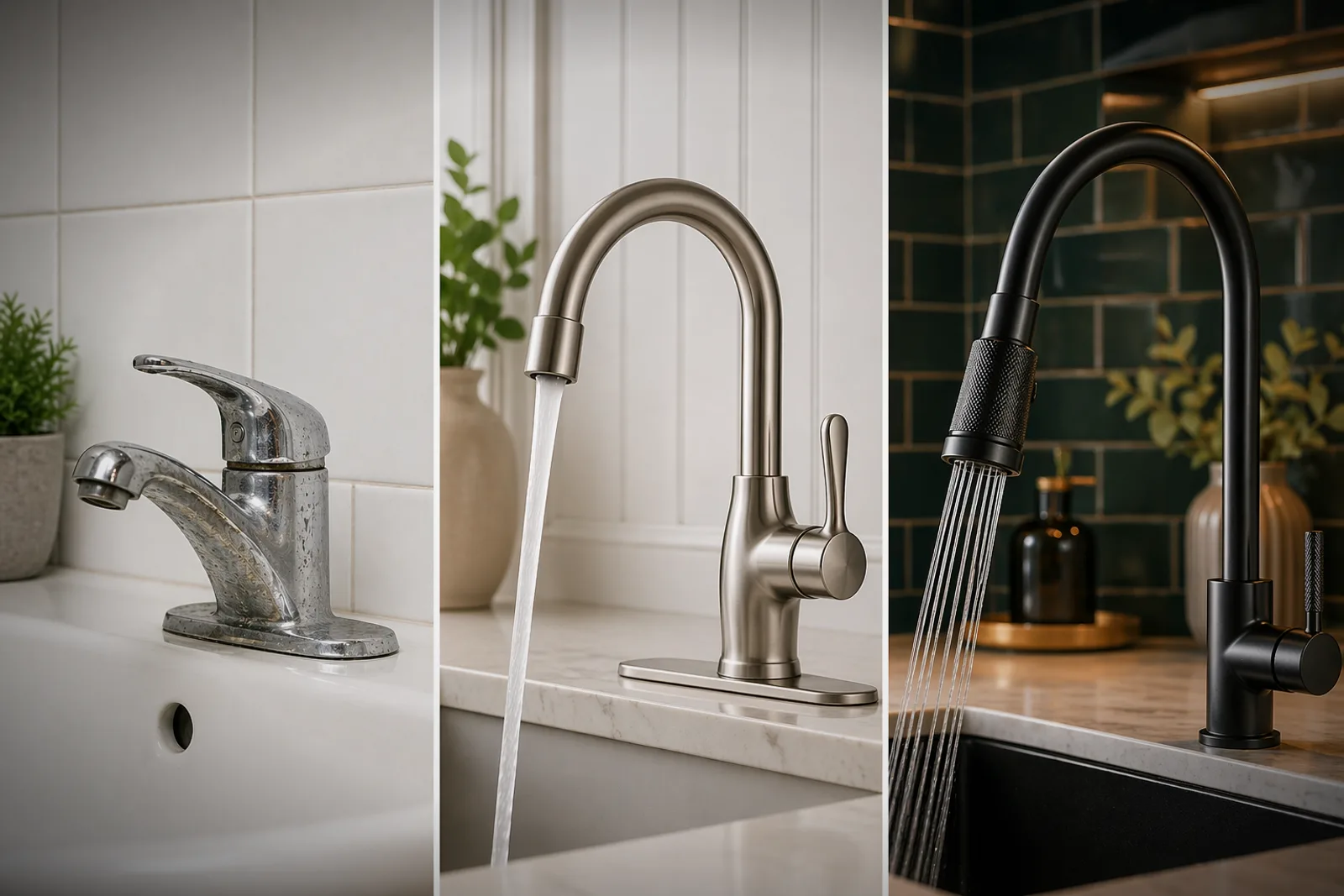
Your Faucet Is a $400 Decision That Saves You $2,000 (A Fixture Buyer's Guide)
Behind every bathroom fixture is an engineering decision that determines whether it works beautifully for 15 years or becomes a plumber's house call in 3.
The Fixture Lie You've Been Sold
Walk into any big-box home improvement store and the bathroom fixture aisle tells a familiar story: rows of chrome faucets ranging from $49 to $499, all looking roughly the same under fluorescent lighting. The $49 version has a nice finish. It turns on and off. Water comes out. The $499 version... also has a nice finish, turns on and off, and water comes out.
So why would anyone spend 10x more?
Because the thing that separates a $49 faucet from a $499 faucet isn't what you can see. It's what you can't: the valve cartridge inside, the materials behind the finish, the engineering of the connections, and the warranty that backs it all up.
Here's the uncomfortable math most homeowners discover too late: a $49 faucet replaced three times over 10 years costs $147 plus three plumber visits at $150-$250 each = $597-$897 total. A $400 Hansgrohe faucet installed once costs $400. Plus it never drips, never leaks, and carries a manufacturer's warranty that actually means something.
The "expensive" fixture is the cheap one. The "cheap" fixture is the expensive one. This is the fundamental inversion that the big-box stores don't want you to understand.
"The expensive fixture is the cheap one. The cheap fixture is the expensive one. This fundamental inversion is what the big-box stores don't want you to understand."
What Actually Matters Inside a Faucet
The Cartridge: Where Quality Lives or Dies
The cartridge is the mechanism inside the faucet that controls water flow and temperature. It's the part that gets used 8-15 times per day, every day, for the life of the faucet. It's also the part that fails first in cheap fixtures.
Ceramic disc cartridge (Hansgrohe, Grohe, TOTO): Two precision-ground ceramic discs that rotate against each other to control flow. Ceramic doesn't corrode, doesn't wear from friction, and maintains a watertight seal for 500,000+ cycles. At 10 uses per day, that's 137 years of theoretical life. These cartridges are the reason quality faucets don't drip.
Plastic/rubber cartridge (most big-box brands): A rubber washer or plastic ball valve that compresses to stop water flow. Rubber degrades from contact with Houston's chlorinated water (1.5-2.0 ppm). The degradation timeline: firm seal for year 1, slight drip by year 2, steady drip by year 3, plumber call by year 4.
The cartridge is a $15-$30 part inside the faucet. The difference between ceramic and rubber is about $10 at the manufacturing level. But that $10 determines whether your faucet lasts 3 years or 15.
"The cartridge is a $15-$30 part inside the faucet. The difference between ceramic and rubber is about $10 at the manufacturing level — but that $10 determines whether your faucet lasts 3 years or 25."
The Finish: Plating Thickness Matters
Every chrome or brushed nickel faucet starts as a base metal (usually brass or zinc alloy) that's electroplated with a decorative finish. The difference is in the plating layers:
Quality fixtures (Hansgrohe, Grohe): Multiple plating layers — copper base, nickel intermediate, chrome finish — totaling 0.5+ microns. This layered approach prevents the base metal from corroding through and creates a finish that resists fingerprints, water spots, and the gradual clouding that cheap chrome develops.
Budget fixtures: Single or double layer plating, thinner application. The finish looks identical on day one. By month 18 in Houston's humid, hard-water environment, you'll see the difference: spotting that doesn't wipe off, dull patches around the base, and eventually pitting where the base metal shows through.
PVD (Physical Vapor Deposition) finishes: The premium tier — available from Hansgrohe and others in brushed gold, matte black, and other designer finishes. PVD bonds the color at a molecular level, making it essentially scratch-proof. These finishes cost 20-40% more but are the only option that maintains appearance in high-use areas over 10+ years.
The Connection: How It Attaches to Your Plumbing
This is the detail that plumbers notice and homeowners don't — until something leaks.
Spec for Houston: choose brass supply connections (not plastic — brittle in 3-5 years), PVD finish over standard chrome (won't pit or peel in humidity), and ceramic disc cartridges over rubber (ceramic lasts 20+ years without dripping). These specs add $50-$150 per fixture and eliminate 90% of bathroom callbacks.
Quality fixtures use brass supply connections with precision threads and integrated O-rings. Brass doesn't crack, threads don't strip, and the connection gets tighter over time as the O-ring seats.
Budget fixtures use plastic supply connections that feel adequate during installation but become brittle after 3-5 years of exposure to hot water cycling. The failure mode: a hairline crack at the connection point that produces a slow leak inside the vanity cabinet. You discover it when the cabinet floor is soft and the wood is black with mold.
The Fixture-by-Fixture Guide: What to Buy for a Houston Bathroom
Bathroom Faucet: Hansgrohe Talis or Metris Series
Cost: $250-$450
Why: Ceramic disc cartridge, brass construction, multi-layer chrome or PVD finish, and a 15-year manufacturer's warranty. The Metris line has a slim, modern profile that works in both contemporary and transitional bathrooms. The EcoSmart flow limiter saves 60% on water without affecting perceived pressure — relevant in Houston where water rates have increased 22% since 2022.
Toilet: TOTO Drake II or Ultramax II
Cost: $350-$550
Why: TOTO's CeFiONTect glaze is a ceramic surface treatment that's molecularly smoother than standard porcelain. In practical terms: waste and bacteria don't stick, the bowl stays cleaner between uses, and you need less cleaning product and less effort. The Tornado Flush system uses centrifugal force instead of gravity holes — more complete flush, less water (1.28 GPF), and no rim to grow bacteria.
What we don't recommend: Smart toilets with heated seats, automatic lids, and bidet functions priced at $3,000-$8,000. If you want a bidet, add a TOTO Washlet seat ($350-$800) to a standard toilet. Same function, 70% less cost, and if the electronics fail, you replace the seat — not the entire toilet.
Showerhead: Hansgrohe Raindance or Grohe Rainshower
Cost: $200-$500 (head only; valve system separate)
Why: Air-injection technology mixes air into the water stream, creating larger, softer droplets that feel like more water while using less. The 10-12" head diameter delivers full coverage — no more repositioning yourself to rinse shampoo from both sides.
The valve matters more than the head. A $500 showerhead on a $50 pressure-balancing valve is a waste. Invest in a thermostatic mixing valve (Hansgrohe iBox universal: $250-$400) that maintains exact temperature regardless of other water use in the house. This is the invisible upgrade that makes the shower feel professional.
Accessories: Towel Bars, Robe Hooks, TP Holders
Cost: $50-$150 per piece (quality) vs. $15-$30 per piece (budget)
Why quality matters here: Bathroom accessories get yanked, pulled, and loaded beyond their intended weight daily. The $15 towel bar from the big box is held to the wall by plastic anchors and a zinc alloy mounting plate. It pulls out of the drywall within 18 months — especially in Houston's humidity, where drywall anchors lose grip faster.
Quality accessories (Hansgrohe Logis, Grohe Essentials) use concealed mounting plates screwed directly into studs or toggle-bolted into drywall. They don't move. They don't pull out. And the finish matches your faucet because they're from the same manufacturer — a detail that makes the bathroom look intentionally designed rather than assembled from clearance bins.
The Total Fixture Budget: Where the Real Cost Lands
Here's how the three tiers compare for a full bathroom fixture package:
- Budget tier ($355-$800 upfront): $600-$1,500 in replacement costs over 10 years. 10-year total: $955-$2,300.
- Quality tier / Craftwork standard ($1,300-$2,500 upfront): $0-$200 in replacement costs over 10 years. 10-year total: $1,300-$2,700.
- Ultra-luxury tier ($5,900-$15,500 upfront): $0-$500 in replacement costs over 10 years. 10-year total: $5,900-$16,000.
The quality tier costs $345-$400 more upfront than budget — and breaks even by year 3 when the budget fixtures need their first replacements. Over 10 years, quality fixtures cost roughly the same total dollars as budget fixtures, while delivering a dramatically better daily experience and zero plumber visits.
The HGTV Reframe
The $15,500 ultra-luxury fixture package exists for the same reason the $120,000 kitchen exists: it's built for a market that values brand prestige over material performance.
A TOTO Drake II flushes identically to a $5,000 smart toilet — it just doesn't warm the seat. A $400 Hansgrohe faucet delivers the same ceramic disc reliability as a $1,200 Dornbracht — it just doesn't say "Dornbracht" on the box. The engineering is equivalent. The premium is positioning.
At Craftwork, we specify fixtures in the quality tier because that's where the engineering-per-dollar peaks. You get the performance and longevity of premium fixtures without paying for the branding.
The Bottom Line
Every bathroom fixture is a bet on the future. The cheap bet says "I'll deal with it when it breaks." The smart bet says "I'll pay 2x more now to never deal with it again."
"Every bathroom fixture is a bet on the future. The cheap bet says 'I'll deal with it when it breaks.' The smart bet says 'I'll pay 2x more now to never deal with it again.'"
At Craftwork, we've installed thousands of fixtures across Houston bathrooms. We know which ones get callbacks (almost none from Hansgrohe and TOTO) and which ones generate emergency calls (the ones that were "just as good" at half the price). The data is clear. The math is clear. The morning experience is clear.
Ready to spec your bathroom fixtures with engineering data, not guesswork? [Book a fixture consultation →]
Sources: Hansgrohe and TOTO technical specifications, Consumer Reports fixture reliability data (2023-2025), Houston water quality reports (City of Houston Public Works), Craftwork fixture performance records (Houston metro), EPA WaterSense certification standards.