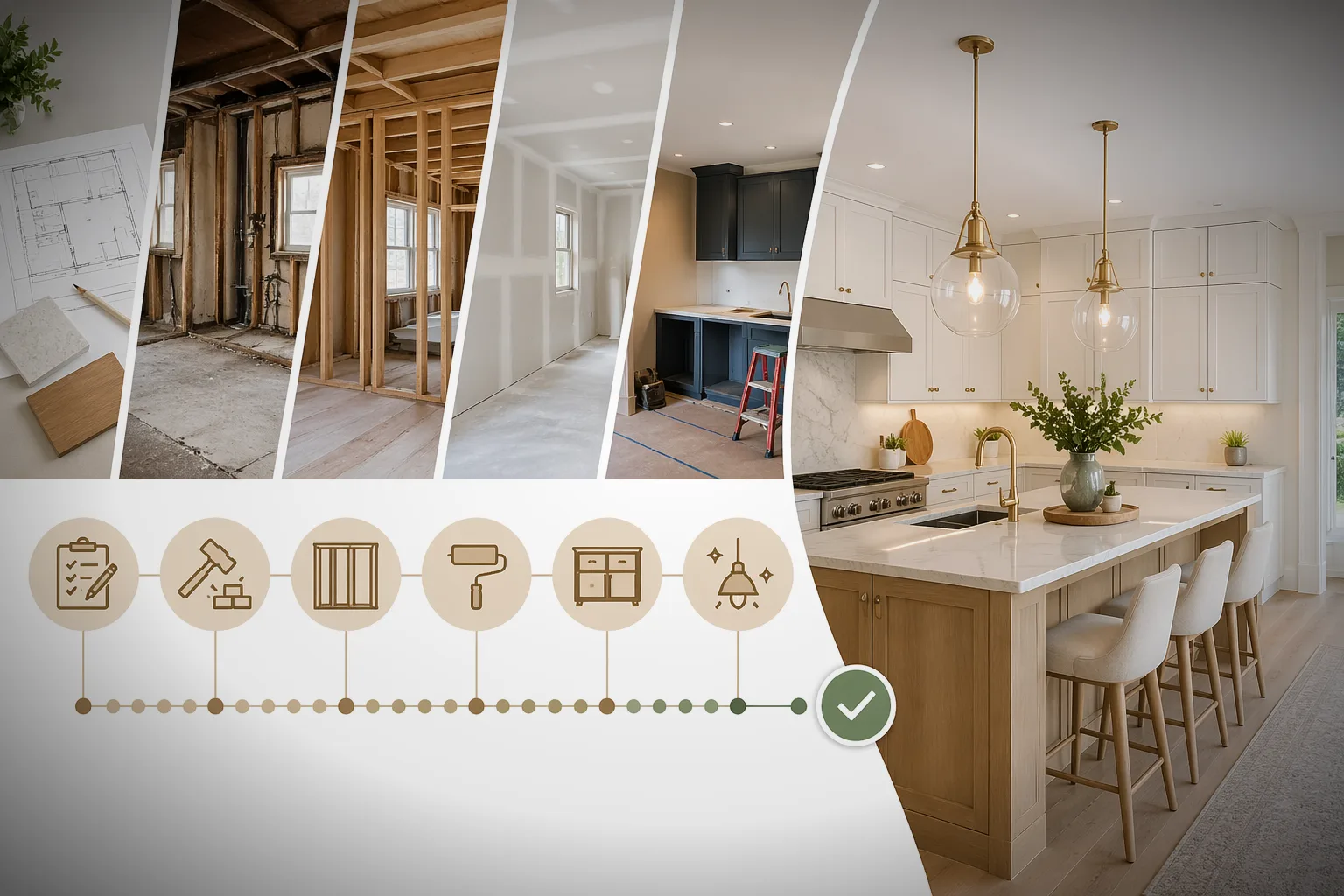
The 21-Day Kitchen Renovation Timeline — What Actually Happens Each Day
A day-by-day breakdown of a full kitchen gut renovation, from demo to final walkthrough — so you know exactly what to expect.
Why Timelines Matter More Than You Think
The number one source of renovation anxiety isn't cost — it's uncertainty about time. "How long will my kitchen be unusable?" "When will the noise stop?" "Are we going to be eating takeout for three months?"
Most contractors answer with a range so wide it's meaningless: "Usually 6-12 weeks." That tells you nothing. It's the time equivalent of "the renovation costs between $30,000 and $80,000."
"Most contractors answer with a range so wide it's meaningless. A timeline that runs 6-12 weeks tells you nothing — it's the time equivalent of an estimate."
At Craftwork, we map every project to a day-by-day timeline before demo begins. Not because construction is perfectly predictable — it's not — but because knowing what SHOULD happen on Day 7 means you'll notice immediately if Day 7 doesn't go to plan.
Here's the standard roadmap for a full kitchen gut renovation (no layout changes). Layout changes add 5-10 days depending on structural work.
Pre-Construction: Weeks -4 to 0 (Before Demo Day)
Week -4: The Design Lock
- All finish selections finalized: cabinet style, countertop color, tile, hardware, fixtures, paint
- Detailed scope document signed (every outlet, every surface, every fixture specified)
- Fixed quote accepted
- Cabinet order placed (lead time: 3-4 weeks for semi-custom)
Week -3 to -1: Procurement & Prep
- All materials ordered and delivery dates confirmed
- Tile, grout, thin-set, cement board delivered to our warehouse
- Countertop fabricator scheduled for template day (Day 11 of construction)
- Permits pulled (electrical and/or plumbing as required)
- Your PM sends you a "living without a kitchen" guide: where to set up a temporary coffee station, microwave, and dishwashing area
Week 0, Day -1: Barrier Setup
- Dust containment barriers installed: plastic sheeting floor-to-ceiling on every opening from kitchen to living spaces
- Drop cloths on all adjacent flooring
- Temporary pathway marked for foot traffic to other rooms
- Appliances disconnected and staged for removal
This pre-construction phase is where most delays originate — not during construction itself. If cabinets aren't ordered until Week -2, or if tile selections aren't finalized, the entire schedule shifts. At Craftwork, we don't schedule demo until every material is confirmed.
Phase 1: Demolition (Days 1-2)
Day 1: Existing cabinets, countertops, and backsplash removed. Flooring pulled up. Old fixtures disconnected and removed. First dumpster load hauled.
Day 2: Remaining demolition completed. Walls stripped to studs where new tile will go. Old electrical and plumbing exposed for inspection. Site cleaned and prepped for rough-in.
What you'll experience: This is the loudest phase. Sledgehammers, pry bars, sawzalls. The crew will work 7:30 AM to 4:30 PM. By end of Day 2, your kitchen will look like a construction site — and that's exactly right. It means everything old is gone and the canvas is clean.
Communication: Your PM texts you photos at end of day with a summary: "Demo complete. Found [X] behind the wall — here's how we're addressing it." No surprises.
Phase 2: Rough-In (Days 3-5)
Day 3: Electrical rough-in begins. New circuits run from the panel to outlet locations per the approved plan. Junction boxes installed for under-cabinet lighting, pendants, and switches.
Day 4: Plumbing rough-in. Supply and drain lines positioned for the new sink location (if changed) or refreshed in place. Dishwasher hookup prepped. Gas line for range verified or installed.
Day 5: Inspections (if required by permit scope). Electrical and plumbing inspectors verify code compliance before walls close up. Any corrections made same-day.
What you'll experience: Quieter than demo. The kitchen looks worse (exposed studs, wires, pipes) but the infrastructure is going in. This is the skeleton of your new kitchen.
The contingency window: Days 3-5 is when we discover what's behind the walls. Corroded galvanized pipes, outdated wiring, moisture damage to the subfloor. The contingency budget exists for exactly this moment. Your PM will text you photos of anything found, explain the fix, and confirm it's covered — no change order.
Phase 3: Drywall, Substrate & Prep (Days 6-8)
Day 6: New drywall hung where needed. Cement board installed behind all tile areas. Subfloor repaired or replaced if needed.
Day 7: Drywall taping, first mud coat. Cement board seams taped and sealed.
Day 8: Second mud coat. Sanding. Primer on all wall surfaces. Floor prepped for tile or flooring installation.
What you'll experience: The quietest phase. Mudding and sanding are low-noise, low-drama. The kitchen starts looking like a room again instead of a job site.
Phase 4: Cabinets & Countertop Template (Days 8-12)
Days 8-10: Cabinet installation. Each cabinet individually leveled (Houston foundations require shimming — expect 1/4" to 1/2" variation across a typical kitchen floor). Upper cabinets mounted to studs with structural screws. Blum soft-close hardware installed and adjusted.
Day 11: Countertop fabricator templates. They'll spend 2-3 hours measuring every surface, marking sink and cooktop cutouts, confirming edge profiles. This template determines the precision of the final countertop — it's not a step to rush.
Day 12: Electrical finish work begins. Outlets and switches installed. Under-cabinet LED strips wired and tested. Pendant fixtures roughed in (final installation after countertops).
What you'll experience: Excitement. Cabinets make it real. This is the first day it starts to look like your new kitchen. The smell shifts from drywall dust to wood.
Phase 5: Flooring & Backsplash (Days 13-16)
Days 13-14: Floor tile or LVP installation. Underlayment, precise layout, cuts around cabinets and island. Grout (if tile) following day.
Days 15-16: Backsplash tile installation. This follows flooring so the tile sits on top of the countertop line cleanly. Grout and cleanup.
What you'll experience: The kitchen is coming together visually. Floor, cabinets, and backsplash create 80% of the visual impact. You'll start seeing the room you designed.
Phase 6: Countertops, Fixtures & Finish (Days 17-21)
Day 17: Countertops installed. Fabricated from the Day 11 template, delivered and set by the stone fabricator. Undermount sink installed.
Day 18: Plumbing connections completed. Sink, faucet, dishwasher, garbage disposal all hooked up and tested under pressure.
Day 19: Appliances installed and tested. Range connected (gas or electric), microwave mounted, dishwasher run through a cycle.
Day 20: Paint touch-ups, cabinet hardware installed, all trim and transitions completed. Pendant lighting hung and aimed.
Day 21: Final cleaning. Dust barriers removed. Thorough wipe-down of all surfaces. Appliance manuals organized. Final walkthrough with your PM.
The Seasonal Booking Window
Houston's renovation calendar has sweet spots and crush periods:
- Jan-Feb — Low demand. Post-holiday budget recovery. Fastest scheduling, best crew availability.
- March-May — Rising demand. Tax refunds, spring motivation. Book 4-6 weeks out.
- June-Aug — High demand. Summer "get it done" push. Book 6-8 weeks out, some material delays.
- Sept-Oct — Peak demand. Pre-holiday completions. Longest lead times, premium scheduling.
- Nov-Dec — Low demand. Holiday slowdown. Good availability but holiday disruptions.
The Craftwork recommendation: Book your consultation in January or February for a March-April start. You get the best crew availability, the shortest material lead times, and you're enjoying your new kitchen before summer entertaining season.
Best time to book: January or February for a March-April start — lowest demand, best crew availability, fastest scheduling. Avoid September-October (peak demand, longest lead times). If you book in peak season, add 2-3 weeks to every phase estimate.
What Happens When Things Go Wrong
They will. Not catastrophically — but something on every project deviates from the plan. Here's how we handle the common ones:
"Something will deviate on every project. Not catastrophically — but it will. The difference is whether your contractor communicates within 24 hours or ghosts you until it's a problem."
Material delay (cabinet backorder): We confirm all material availability before scheduling demo. But if a supplier misses a date, we re-sequence: pull forward work that doesn't depend on the delayed item (flooring, electrical) and push the dependent phase back. Your PM communicates the adjusted timeline within 24 hours.
Inspection delay: Houston permit inspectors sometimes reschedule. We build a 1-day buffer into Phase 2 for exactly this. If the inspector no-shows, we continue with non-dependent work and reschedule for next day.
Discovery behind walls: This is what the contingency covers. The timeline impact depends on severity: minor subfloor patch (no delay), pipe replacement (half-day delay), electrical panel issue (1-2 day delay). Your PM texts you the moment it's found, with photos and the plan.
The Bottom Line
A renovation timeline isn't a guess — it's a commitment. When every day is mapped and every contingency is planned for, you can schedule your life around the construction instead of living in constant uncertainty.
"A renovation timeline isn't a guess — it's a commitment. When every day is mapped and every contingency is planned, you schedule your life around the project, not around uncertainty."
At Craftwork, we hit our timeline on 95%+ of projects — not because we're lucky, but because we do the hard planning work before Day 1. The cabinets are ordered. The permits are pulled. The contingency is budgeted. The only thing left is execution.
Ready to see your project's timeline mapped out? [Book a consultation →]
Sources: Craftwork project timeline data (2024-2026, Houston metro), National Association of Home Builders renovation duration benchmarks, City of Houston permit processing timelines, Craftwork client satisfaction surveys.