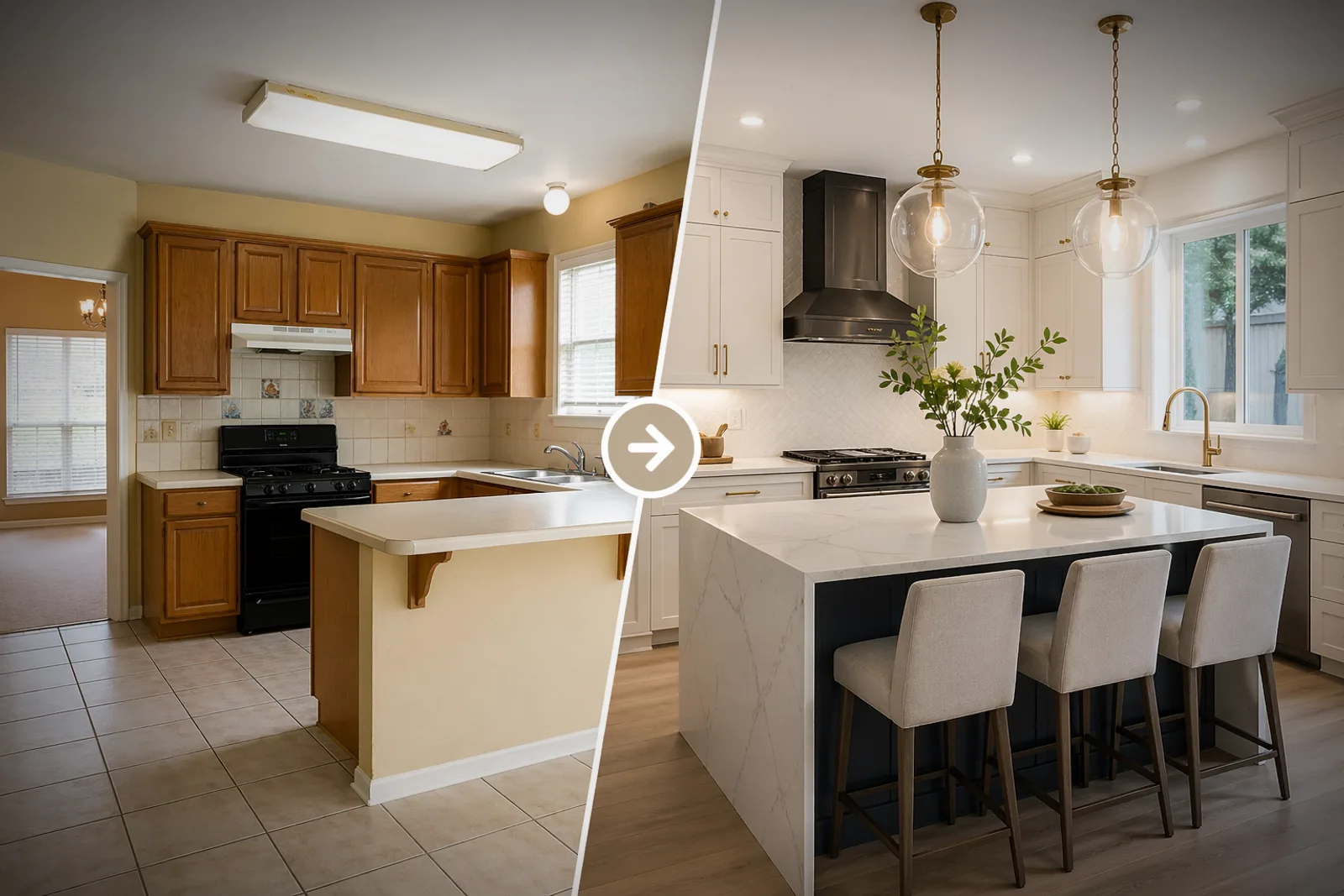
The 1990s Houston Kitchen Is Expiring
If you bought a builder-grade home in Katy, Sugar Land, Pearland, or Cypress between 1995 and 2010, the kitchen came with an invisible expiration date. It's running out.
The Countdown You Didn't Know Was Running
When you bought the house in 2018 or 2020, the kitchen probably looked "fine." Maybe a little dated, but functional. White MDF cabinets with a faux-shaker profile. Laminate counters that wanted to be granite. A fiberglass backsplash. Beige tile. Brushed nickel pulls. Everything in working order, nothing obviously broken.
What you didn't know — what your realtor didn't mention and what the previous owner maybe didn't want to think about — is that almost everything in that kitchen was engineered for a 15-20 year service life. The house is now in year 25, 28, sometimes 30. The countdown clock is running out on all of it at the same time.
Here's what that actually looks like, year by year, in a typical Houston builder-grade home from the 1990s-2010s era.
By year 15 to 18, MDF cabinet boxes begin to absorb ambient humidity. Edges of doors start to swell slightly. Interiors remain intact but drawer bottoms sag. Soft-close hardware, if there was any, fails.
By year 18 to 22, the laminate backsplash and countertop edges begin delaminating in corners near the sink. The thin veneer on the cabinet doors starts peeling where it meets the stile. Faucets with standard cartridges begin to drip under Houston water hardness of 120 to 200 milligrams per liter.
By year 22 to 26, the fiberglass tub surround in the main bath develops hairline cracks along stress points. The grout in the backsplash turns permanently gray because it was never sealed. Cabinet doors that used to close flush now hang at a slight angle.
By year 26 to 30, structural failures start. Subfloor rot under the sink because the plumbing penetrations were caulked, not sealed. Door panels visibly bowed. Cabinet boxes split at the seams. Drawer runners dead. One morning you open a drawer and the front comes off in your hand.
Past year 30, you're living in a kitchen that is failing around you in slow motion. You'll spend the next decade making "temporary" fixes — new drawer fronts, re-caulking counters, replacing individual fixtures — that aggregate to more than what a real renovation would have cost.
"Your kitchen isn't broken yet. It's on the back half of its engineered service life, all of it, at the same time."
This is not a trick. It's the engineered service life of builder-grade materials meeting the engineered reality of time. The entire 1990s-2000s Houston suburban housing boom is reaching the end of its first material cycle right now, simultaneously, across hundreds of thousands of homes.
The Houston-Specific Acceleration
Houston conditions accelerate this timeline compared to dry climates. Three factors compound to shorten every manufacturer's warranty expectation.
Humidity is the first factor. Houston averages 75% relative humidity year-round. Most Northern and Western homes average 40 to 55%. MDF, particleboard, and laminate all absorb humidity slowly and invisibly, and Houston humidity is nearly 50% higher than the conditions those materials were tested for. Service life expectations from Midwest manufacturers often don't apply in Houston. The climate is its own accelerator.
Water hardness is the second factor. Houston municipal water runs 120 to 200 milligrams per liter of calcium carbonate — "moderately hard to hard" on the USGS scale. Over years, hard water damages fixture cartridges, scales sink basins, discolors grout, and corrodes metal hardware. Cheap fixtures, the kind builders install, are engineered for soft-water averages. In Houston they fail at accelerated rates.
The third factor is foundation movement. A significant fraction of pre-2000 Houston homes sit on pier-and-beam foundations. Even post-tension slab homes experience some movement in Houston's expansive clay soils. Cabinets and counters installed rigidly to moving substructures crack their caulk joints, stress their hardware, and create a cascade of small failures that weren't in the manufacturer's plan.
A fixture rated "lifetime" in Minneapolis is a 5 to 7 year fixture in Houston. Plan replacement cycles against your climate, not the label on the box.
These three factors compound. A cabinet rated for 20 years in a dry Denver home may last 12 to 15 in a Katy home. A faucet rated for "lifetime" in Minneapolis lasts 5 to 7 years in Houston. The maintenance schedule you'd expect from a manufacturer's warranty is wrong for this climate.
Why This Isn't a Pinterest Problem
Most homeowners in this position try to treat the decaying kitchen as an aesthetic problem. "I just want to update it." They redo the backsplash, paint the cabinets, maybe swap the hardware. Eighteen months later the underlying decay surfaces again and they realize they put lipstick on a structure that needed bones.
The renovation you actually need is a structural refresh, not an aesthetic refresh. Here is what a real structural reset actually touches:
- Replace the cabinet boxes, not just the doors, with plywood-core construction that can handle Houston humidity
- Replace the countertop with non-porous quartz that doesn't absorb moisture or stain
- Upgrade to fixtures with ceramic cartridges that tolerate hard water
- Reinforce the cabinet mounting to handle foundation movement
- Install a proper exhaust fan — most 1990s Houston kitchens have undersized fans
- Update the plumbing supply lines if they're original galvanized (common pre-1985, sporadic 1985-2000)
- Replace the lighting with layered LED circuits — the original fluorescent ballasts are past life anyway
This is not a vanity project. It's a forced upgrade that the calendar is demanding. You are not renovating because you're bored. You're renovating because the materials have timed out.
The Identity Layer: Why "Make It Yours" Actually Matters
Here's the part that generic contractors miss. When you bought a builder-grade house, you didn't just buy a worn-out kitchen. You bought someone else's design decisions.
Someone in a builder's office decided in 1998 that this floor plan would sell. Someone in a procurement meeting decided on beige tile and maple cabinets and brushed nickel hardware because those were safe middle-of-the-road choices that no buyer would reject. Your taste had nothing to do with any of it.
"The house was built for an imaginary average buyer. You were the one who could afford it that year."
That's fine for a starter. It's not fine forever. The research on place-identity (Proshansky, Fabian and Kaminoff, 1983, and ongoing work since) says that humans unconsciously bond with the spaces they inhabit, but that bonding is blocked when the space feels like it belongs to someone else. Sixty-two percent of homeowners say they want to "put their own stamp" on a newly purchased home. Seventy-five percent report some degree of post-purchase regret about choices they didn't make. The regret doesn't go away. It just manifests as a vague dissatisfaction you can't quite articulate — until you renovate and realize, oh, this is what I was missing.
The structural need to update and the emotional need to claim the space show up at the same time. If you have to replace the cabinet boxes anyway, you might as well replace them with a door profile you actually chose. If you have to replace the countertop, you might as well pick the stone that reflects how you want to feel when you walk into the room. This isn't luxury thinking. It's efficient use of a forced renovation cycle.
Cabinets: Plywood Boxes, Not MDF
The cabinet box is the single most important spec decision in a Houston kitchen. Get this wrong and nothing else matters, because the doors and counters will outlive the boxes they sit on. Here is what a Houston-durable cabinet specification looks like:
- Plywood box construction, not MDF or particleboard — a solid plywood box survives humidity where MDF fails
- Face frame or frameless, either works, as long as the doors are solid wood or thermofoil over HDF rather than MDF
- Blum or Grass hardware throughout — these are the industry standards for soft-close hinges and drawer runners, and they'll outlast the house
- Shaker profile is the safest aesthetic choice, used in 58 to 65% of designer kitchens, because it reads "timeless" rather than "era-specific"
Countertops: Quartz or Porcelain Slab
Quartz has overtaken granite as the number-one countertop material (34 to 38% market share versus granite's declining 33% down to 19%) specifically because it's non-porous, doesn't need sealing, and tolerates Houston humidity without developing bacterial or mold issues. For a Houston workhorse kitchen:
- Quartz from Caesarstone, Silestone, Cambria or equivalent is the default
- Porcelain slab (Dekton, Neolith) is also acceptable and increasingly specified for workhorse kitchens
- Avoid marble and limestone in Houston kitchens — they stain, etch, and grow bacteria in humid conditions
Sink: 16-Gauge Single-Bowl Workstation
The workstation sink with built-in accessories now appears in 25 to 30% of new kitchens for a reason — it's more functional than a double bowl for modern cooking. The spec to ask for:
- 16-gauge stainless steel, single bowl, 30 inches or wider
- Integrated accessory rails for cutting boards, drying racks, and colanders
- Avoid composite granite sinks — they chip
- Avoid undermount fireclay — it's heavy and hard to support in MDF cabinetry
Faucet: Ceramic Cartridge, $300 Minimum
Houston water hardness eats cheap fixtures. Below $200 retail you're buying guaranteed failure inside five years. What works here:
- Pull-down sprayer with ceramic cartridge
- $300 retail minimum — Hansgrohe, Grohe, Delta Trinsic, and Moen Arbor are all proven in Houston conditions
- Solid brass body, not zinc alloy, wherever the spec allows it
Tile: Large-Format Porcelain
Fewer grout lines means fewer failure points and easier cleaning. In a climate where grout discolors faster than anywhere else in the country, that matters. The Houston-durable tile spec:
- Large-format porcelain for floors, 12 by 24 inches or larger
- Backsplash can be ceramic, porcelain, or glass — just install it over cement board, not green board
- Seal the grout at install and reseal every 2 to 3 years
Lighting: Three Circuits, 2700K
The original fluorescent ceiling box in a 1990s builder kitchen is past its service life even if it still works. Replace it with a layered LED system:
- Three circuits on three dimmers, all 2700K for warm color temperature
- Recessed cans for ambient light
- Pendants or under-cabinet LEDs for task light
- Accent lighting somewhere (toe-kick or inside-cabinet) for evening mode
Exhaust: 350+ CFM, Vented Outside
Most 1990s Houston builder kitchens have 200 CFM recirculating hoods that never actually worked. The correct spec for a kitchen where people actually cook:
- 350 CFM minimum range hood, 450 to 600 CFM for serious cooks
- Vented outside, never recirculating
- Ducted through the shortest reasonable path to an exterior wall or roof cap
- Makeup air consideration for hoods above 400 CFM (code in some jurisdictions)
Executed with quality labor, this full spec costs $38,000 to $55,000 for a typical 150 to 200 square foot Houston kitchen. It is engineered to last 25 or more years in Houston conditions — actually engineered, not "rated in a lab somewhere cold and dry."
The Open-Plan Opportunity
There's one more thing about the 1990s Houston kitchen that almost demands addressing during a renovation. The layout is wrong for how people live now.
The original builder floor plans from 1995 to 2005 assumed formal dining rooms, closed-off kitchens, and a family that ate separately from the place they cooked. AIA data shows formal dining is declining 60% as a use-case — people eat in the kitchen or at an island now. The galley kitchen with a small pass-through that was standard in 1998 is incompatible with the way a 2026 Houston family actually operates.
The opportunity during a forced structural renovation is to open the kitchen up. Remove the non-load-bearing wall between the kitchen and the formal dining. Create an island that serves as prep space and breakfast counter and homework station and evening wine spot. Turn the old formal dining into a coffee nook or a reading area or more kitchen storage.
If the wall is already coming out for structural reasons, opening it up fully is typically an $8K to $15K add, not a separate project. The demo, drywall, and paint are already on the invoice.
This adds $8,000 to $15,000 to a renovation but transforms the entire feel of the home. It converts a dated 1990s builder house into one that feels genuinely 2026. It's the single biggest lifestyle improvement available during a kitchen remodel, and because the walls were coming out anyway for structural and material reasons, the incremental cost is modest.
"A forced renovation is also a forced opportunity — the walls are already coming out. The only question is how far."
If you're already going through a forced material refresh, this is the time to do it. Doing it later means ripping up the new kitchen you just paid for.
The Bottom Line
You bought a house with an invisible countdown clock. The clock is running out. The materials are failing. The layout is wrong for 2026 life. The identity of the space still belongs to whoever signed off on it in 1998.
The renovation you need is not cosmetic. It's structural, Houston-specific, and oriented toward 20 or more years of useful life. The budget is $38,000 to $60,000 for most homes. The timeline is 10 to 14 weeks. The result is a kitchen that's genuinely yours, built for Houston, and designed for the way you actually live.
The alternative is five more years of small failures, small fixes, and small dissatisfactions that collectively cost as much as the renovation and leave you with the same tired kitchen at the end.
At Craftwork, we build for Houston specifically — plywood box cabinets, quartz counters, workstation sinks, Hansgrohe fixtures, Schluter waterproofing, proper exhaust, layered 2700K lighting, all installed by crews who've been doing Houston kitchens for a decade and know what the humidity will and won't tolerate. The spec isn't exotic. It's just correct for the climate.
Ready to renovate the Houston kitchen that's been quietly failing around you? Book a builder-grade-reset consultation and we'll walk your space, spec the fix, and give you a number that's built to last.